



Past Events
[Seminar] Prof. Natalia Perkins "Disorder in the Kitaev spin liquid"
Target audience: Interns, Students, PostDocs, and those who are interested in the same research field. Language: English
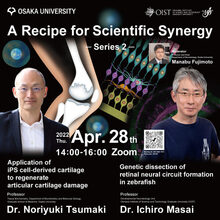
A Recipe for Scientific Synergy Series 2 by Dr. Ichiro Masai and Dr. Noriyuki Tsumaki
OIST - Osaka University: A Recipe for Scientific Synergy-Series 2 by Dr. Noriyuki Tsumaki and Dr. Ichiro Masai
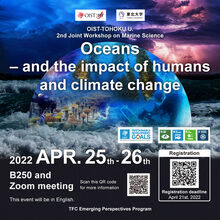
“Oceans – and the impact of humans and climate change” - OIST-Tohoku U. 2nd Joint Workshop on Marine Science
OIST-Tohoku U. 2 nd Joint Workshop on Marine Science “ Oceans – and the impact of humans and climate change ”
[Seminar] Sub-Gaussian heat kernel bounds and singularity of energy measures for symmetric diffusions,Professor Naotaka Kajino (Kyoto University)
This talk will present the result of a joint work with Mathav Murugan(University of British Columbia) that, for a symmetric diffusion on a complete locally compact separable metric space, two-sided sub-Gaussian heat kernel bounds imply the singularity of the energy measures with respect to the reference measure.
For self-similar (scale-invariant) diffusions on self-similar fractals, the singularity of the energy measures is known to hold in many cases by Kusuoka (1989, 1993), Ben-Bassat, Strichartz and Teplyaev (1999), Hino (2005), and Hino and Nakahara (2006), but these results heavily relied on the self-similarity of the space.
It was conjectured, and had remained open for the last two decades to prove, that the singularity of the energy measures should follow, without assuming the self-similarity, just from two-sided sub-Gaussian heat kernel bounds of the same form as those for diffusions on typical self-similar fractals. The main result of this talk answers this conjecture affirmatively.
The first half of the talk will be devoted to a brief introduction to self-similar diffusions (and their associated Dirichlet forms) on self-similar fractals and to sub-Gaussian heat kernel bounds for symmetric diffusions, so that the talk will (hopefully) be accessible even to those without prior knowledge about diffusions on fractals.
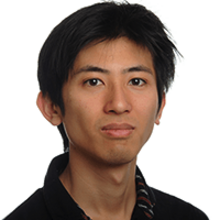
[Seminar] Professor Hidehiko Inagaki: A midbrain-thalamus-cortex circuit reorganizes cortical dynamics to initiate planned movement
[Neuroscience Club] Prof. Hidehiko Inagaki, Research Group Leader, Neural Dynamics & Cognitive Functions Group
We are excited to have an online seminar by Prof. Inagaki from Max Plank Florida Institute for Neuroscience.
You can join the seminar via ZOOM (meeting ID: 782 721 4941, Password: 436475).
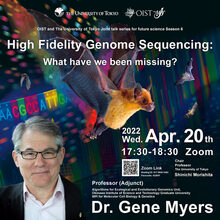
OIST-UT Joint talk series for future science-Season6: High Fidelity Genome Sequencing: What have we been missing?
OIST-UT Joint talk series for future science-Season6: High Fidelity Genome Sequencing: What have we been missing ?
OIST Representation Theory Seminar
[Seminar] Mr. Hong Yang "Duality, Criticality, Anomaly, and Topology in Quantum Spin-1 Chains"
Target audience: Interns, Students, PostDocs, and those who are interested in the same research field. Language: English
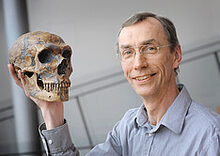
Faculty Lunchtime Seminar (Prof. Svante Pääbo)
Title: What makes human special? A molecular approach
Please welcome Prof. Pääbo, our Adjunct Professor, and join his very first faculty talk at OIST!
Yasha, Akiko, and the CPR team
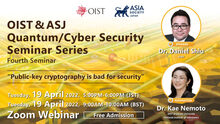
4th QCS Webinar: "Public-cryptography is bad for security" with Dr. Daniel Shiu, Arqit
Dr. Daniel Shiu, Chief Cryptographer of Arqit, a leading company with transformational quantum encryption technology, will speak on "Public-cryptography is bad for security".
Registration link: TUESDAY, 19 APRIL 2022, 5:00PM (JST) | OIST Groups
[Seminar] Prof. Hiroshi Kontani "Exotic QLC states in Fe-based superconductors, kagome metals, and twisted bilayer graphene"
Target audience: Interns, Students, PostDocs, and those who are interested in the same research field.
Language: English

Japan Eco-Evo English Seminar #8: Individual-based temporal beta-diversity: Individual turnover and compositional shift in a community
The seminar aims to initiate interactions between international and Japanese researchers and students in the field of Ecology and Evolution. The 8th event is presented by Ryosuke Nakadai from National Institute for Environmental Studies.
Please register from the next link: https://sites.google.com/view/jee-english-seminar
Title: Individual-based temporal beta-diversity: Individual turnover and compositional shift in a community
Timeline 15:00~15:30: seminar 15:30~16:00: questions and discussion 16:00~: mixer
Abstract: As increasing the necessity to assess the influences of global climate change and anthropogenic disturbances on biodiversity, the concept of beta-diversity has been extended to a temporal context and has been intensively studied in recent years. In studies of temporal beta-diversity, methodologies used in spatial beta-diversity have often been used simply. However, temporal beta-diversity often includes "the same individual" between two communities implicitly, which has not been the case with spatial communities, so it is necessary to consider the effects of individual turnover and persistence for quantifying temporal beta-diversity. I focused on both individual identity and the persistence of individuals within a temporal beta-diversity framework and developed some novel indices. In my presentation, I will explain the novel indices which I recently developed and the concepts behind them, showing examples of analysis. I would also like to discuss the prospects for community assemblages through both time and individual identity.
Ultracold Atoms Japan 2022
OIST Workshop | Main organizer: Thomas Busch (Quantum Systems Unit) | OIST members are welcome to attend all scientific sessions (registration required). | Website | Venue: Seminar Room B250, OIST Main Campus and Online
This conference will be a hybrid conference with both online and on-site attendees. We will accept on-site participants from within Japan only.
We ask for you understanding that the dates are subject to change due to the ongoing COVID-19 situation.
ORC Assembly
The next ORC Assembly will be the last for the previous ORC representatives and the first for the new representatives! Please join us as we hand over to the new office.
Also on the agenda: Future plans of the new office, with plenty of time for discussion, and a report on the recent Faculty Assembly.
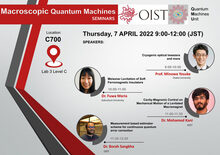
[Seminars] Macroscopic Quantum Machines
These seminars examine the science of how to bring macroscopic (large) systems into the quantum regime. The preparation of large Schrodinger cats is one of the long sought goals of quantum science. Researchers seek to do this for many reasons – to see if it can be done at all – does quantum mechanics still hold for large objects – is there new science that appears when objects become large/massive? Can macroscopic/large quantum systems be useful as precision sensors – and how can we preserve/protect the large scale quantum properties in such systems. These series of talks (experimental and theoretical), will show some facets/aspects of how some researchers are aiming towards the building of large Quantum Cats. Coffee and Okinawan Donuts are supplied during the morning.
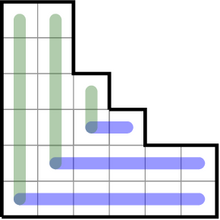
OIST Representation Theory Seminar
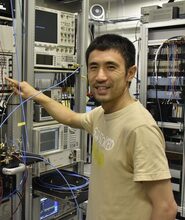
Lunchtime Seminar (Dr. Yuimaru Kubo, STG)
Title: A masing spin ensemble: temperature, light, amplifier, and diamond
Abstract:
I will start discussing two fundamental concepts in nature, temperature and light, followed by one of the indispensable basic components in the modern information society, amplifiers. Then I will try to show that combining these three concepts leads to our ongoing project, a heat-driven coherent microwave oscillator based on a spin ensemble in a diamond crystal.
OIST Representation Theory Seminar
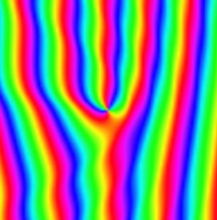
[Seminar] Prof. Michael Berry "Variations on a theme of Aharonov and Bohm"
Target audience: Interns, Students, PostDocs, and those who are interested in the same research field.
Language: English
Virtual Seminar"Analysis of Thixotropy"Yogesh M Joshi
Language: English
[Seminar] Associate Prof.Yosuke Hasegawa "Control of Wall Turbulence and associated Transport Processes"
Target audience: Interns, Students, PostDocs, and those who are interested in the same research field.
Language: English
OIST-UT Genomics Research Seminar (Day2 of 2)
A 2-day seminar held by Algorithms for Ecological and Evolutionary Genomics (Gene Myers) Unit along with Genomics and Regulatory Systems (Nicholas Luscombe) Unit as the co-host.
In the seminar, entitled " OIST-UT Genomics Research Seminar ", we invite 3 Ph.D. students from The University of Tokyo (Shinichi Morishita lab) to OIST, and each of the 8 researchers in total from UT and OIST will give a 20 min talk on their work plus 10 min Q&A session.
The seminar will be held on site at OIST, although you can also join via zoom (link below). On each day, right after the seminar we will have time and place for further discussion and interaction with the presenters (while keeping distance).
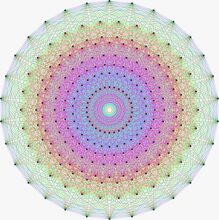
Three lectures on modular Lie algebras (Part III)
Susumu Ariki, Osaka University
Title: Three lectures on modular Lie algebras (Part III)
OIST-UT Genomics Research Seminar (Day1 of 2)
Three lectures on modular Lie algebras (Part II)
Susumu Ariki, Osaka University
Title: Three lectures on modular Lie algebras (Part II)
Theoretical Physics Seminar: Yasha Neiman (part 2)
Theoretical Physics Seminar. Speaker: Yasha Neiman (Quantum Gravity). Title: "A new kind of Feynman rules: what is Higher Spin Gravity? (part 2)"
Three lectures on modular Lie algebras (Part I)
Susumu Ariki, Osaka University
Title: Three lectures on modular Lie algebras (Part I)
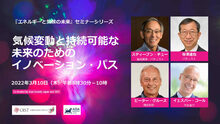
OIST x ASJ 「エネルギーと気候の未来」セミナーシリーズ
OIST x ASJ 「エネルギーと気候の未来」セミナーシリーズ
[Seminar] Supercaloric functions for the parabolic p-Laplace equation in the fast diffusion case, Juha Kinnunen, Aalto University
This talk discusses a generalized class of supersolutions, so-called \(p\)-supercaloric functions, to the parabolic \(p\)-Laplace equation. This class of functions is defined as lower semicontinuous functions that are finite in a dense set and satisfy the parabolic comparison principle. Their properties are relatively well understood in the slow diffusion case \(p>2\), but little is known in the fast diffusion case \(1
[Mini-course] Curvature and Optimal transport | Professor Asuka Takatsu, Tokyo Metropolitan University
In this series of lectures, I first review the notion of curvature (Gaussian curvature and Ricci curvature). In particular, I recall some comparison theorems (Toponogov's triangle comparison theorem, Bishop--Gromov volume comparison theorem etc). Then I introduce a generalized notion of curvature in non-smooth spaces.
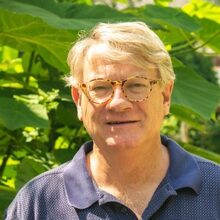
[Seminar] Prof. Robert Joynt "Evanescent-wave Johnson Noise"
Target audience: Interns, Students, PostDocs, and those who are interested in the same research field.
Language: English
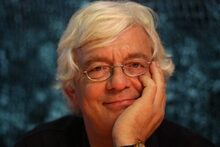
Keynote Lecture by Dr. Marin van Heel (Cryo-Electron Microscopy Course)
Kyenote Lecture for CryoEM Course
OIST Representation Theory Seminar
Speaker: Robert Spencer, University of Cambridge
Title:(Some) Gram Determinants for \(A_n\) nets

(Somewhat) Functional Journal Club
[Seminar] Prof. Bumjoon Kim "Intertwinned Néel and spin nematic orders in a square-lattice antiferromagnet"
Target audience: Interns, Students, PostDocs, and those who are interested in the same research field.
Language: English
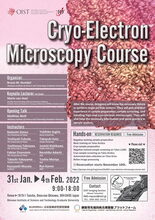
FY2021 Cryo-Electron Microscopy Course at OIST
Internal and External workshop
Theoretical Physics Seminar: Yasha Neiman
Theoretical Physics Seminar. Speaker: Yasha Neiman (Quantum Gravity). Title: "A new kind of Feynman rules: what is Higher Spin Gravity?"
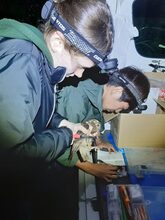
Determining Habitat Occupancy of Okinawa's Owl Species Using Passive Acoustic Monitoring
Cassie George is an RSD intern working with the Environmental Informatics Section in collaboration with the Takagi lab at Hokkaido University

QG group meeting: a little bit from everyone
Quantum Gravity group meeting. Short stories by everyone.
[Catch-All Math Colloquium] Monge-Ampère equations related to optimal transport and geometric optics, Jun Kitagawa, Michigan State University
In the mathematics part, we will hear an exciting overview talk for a general audience. In the discussion session, we will hear about the speaker's experience as a mathematician. Y ou can take inspiration from them and exchange ideas with other participants in a small group. After the sessions are over, there will be a tea time where participants can chat freely.
第5回おきなわオープンTECHゼミ The 5th Seminar of Okinawa Open Facilities Network (OoPNet)
Title : Development of helium recycling network in Okinawa Date and time : Tuesday, February 22, 2022 15:00-16:00 Speakers : Kazuma Takada (OIST) , Hisaya Munemoto (University of the Ryukyus) Language : Japanese Registration required
Faculty Lunchtime Seminar (Prof. Armitage)
Title : Context-dependence and generality in community ecology - two sides of the same coin?
Abstract : Community ecology is often derided for its lack of general theory. Factors limiting one population's growth can be insignificant elsewhere. While this flavor of context-dependence clearly impedes a predictive theory of ecology, it also paradoxically functions as a very general mechanism that maintains biodiversity. I will review how a context-dependent competition theory can clarify the general mechanisms underlying species coexistence and geographic range limits. I'll then riff on the theme of ecological context-dependence as it pertains to our unit members' work on carnivorous plants, pestiferous bats, and noxious roadside weeds.
https://groups.oist.jp/faculty-lunch
Zoom seminar for OIST "Bridging the genotype-phenotype-fitness divide: from protein interfaces to organismal fitness"
Protein Engineering and Evolution Unit would like to invite you to a seminar!
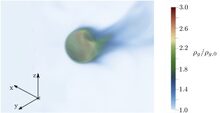
[Seminar] Mr. Nicolo Scapin "Weakly compressible simulation of evaporating droplets"
Target audience: Interns, Students, PostDocs, and those who are interested in the same research field.
Language: English

Annual Inspection_Ultracentrifuge [Hitachi Koki]
Annual Inspection_Ultracentrifuges
OIST Representation Theory Seminar
Speaker: Stephen Doty, Loyola University Chicago
Title: Schur-Weyl duality for braid and twin groups via the Burau representation
Quantum Birds: The Magnetic Compass Sense of night-migratory Songbirds
Quantum Birds: The Magnetic Compass Sense of night-migratory Songbirds
Prof. Henrik Mouritsen
Institute of Biology and Environmental Sciences, University Oldenburg,
Prof. Mouritsen will present how night-migratory songbirds seem to use a quantum mechanical mechanism to sense magnetic compass information which they use to navigate with exquisite precision over thousands of kilometres (Mouritsen 2018). In the past years, evidence has mounted that migratory birds use a light-dependent, radical pair-based mechanism to sense the axis of the geomagnetic field lines (Hore & Mouritsen 2016). The magnetic compass of night-migratory birds is sensitive to anthropogenic electromagnetic field disturbances being ca. 1000 times weaker than the current WHO guideline limits (Engels et al. 2014; Schwarze et al. 2016). This result could be significant in relation to migratory bird conservation measures and strongly indicates that the basic sensory mechanism underlying the magnetic compass of night-migratory songbirds should be based on quantum mechanical principles rather than classical physics. Neuroanatomical data have shown that magnetic compass information is detected in the eye and then processed in a small part of the thalamofugal visual pathway terminating in the visual processing centre “Cluster N” (Mouritsen et al. 2005; Liedvogel et al. 2007; Feenders et al. 2008; Zapka et al. 2009). When Cluster N is deactivated, migratory European Robins can no longer use their magnetic compass, whereas their star compass and sun compass abilities are unaffected (Zapka et al. 2009). The lagena and associated pathways remained intact. Bilateral section of the trigeminal nerve had no effect on the birds’ ability to use their magnetic compass (Zapka et al. 2009). Very recently, we could also show that the light-sensitive protein Cryptochrome 4 from a night-migratory songbird is magnetically sensitive in vitro based on a radical-pair mechanism (Xu et al. 2021).
Zoom link
OIST Representation Theory Seminar
[Seminar] Instability and turbulence in electroconvective flows
CFF unit is pleased to invite you to the seminar.

Theoretical Ecology Seminar/Discussion Series
Theoretical Ecology Seminar/Discussion Series