



Events
[Seminar] "Towards a Bogomolov-Miyaoka-Yau inequality for symplectic 4-manifolds, II" by Paul Feehan
Paul Feehan (Rutgers University): October 13, 2:30pm-3:30pm, lecture room L5D23.
Title: Towards a Bogomolov-Miyaoka-Yau inequality for symplectic 4-manifolds, II
Abstract: The Bogomolov-Miyaoka-Yau inequality for minimal compact complex surfaces of general type was proved in 1977 independently by Miyaoka, using methods of algebraic geometry, and by Yau, as an outgrowth of his proof of the Calabi conjectures. In this talk, we describe progress in our ongoing program to prove the conjecture that symplectic 4-manifolds obey the Bogomolov-Miyaoka-Yau inequality. Our program uses Morse theory on the gauge theoretic moduli space of non-Abelian monopoles, where the Morse function is a Hamiltonian for a natural circle action and natural two-form. We shall describe generalizations of Donaldson’s symplectic subspace criterion (1996) from finite to infinite dimensions and generalizations of Taubes' perturbation analysis from the Seiberg-Witten to non-Abelian monopole equations. These methods have application to the problem of showing that the fundamental two-form is non-degenerate and thus an almost symplectic form on the moduli space of non-Abelian monopoles. This talk is based on joint work with Tom Leness and the monographs https://arxiv.org/abs/2010.15789 (to appear in AMS Mathematical Surveys and Monographs), https://arxiv.org/abs/2206.14710 and https://arxiv.org/abs/2410.13809 .
[Seminar] "Universal Link Invariants via Configuration Spaces" by Cristina Ana-Maria Anghel
Cristina Ana-Maria Anghel (Université Clermont Auvergne): October 13, 4pm-5pm, lecture room L5D23 (online talk).
Title: Universal Link Invariants via Configuration Spaces
Abstract: Coloured Jones and Alexander polynomials are quantum invariants originating in representation theory and their geometric information is an important open problem in quantum topology. We present a new topological perspective that unifies these invariants through the topology of configuration spaces. First, for a fixed N, we define new link invariants: "N-th Unified Jones invariant" and "N-th Unified Alexander invariant" globalising all coloured Jones and ADO link polynomials of (multi)-colours bounded by N. Asymptotically, Habiro defined his universal knot invariant globalising coloured Jones polynomials by introducing the Habiro ring. For the link case, such globalisation remained open for both sequences of invariants. We answer this problem coming from representation theory using topological tools. On the representation theory side we define extensions of Habiro type rings. On the topological side, we construct a universal Jones link invariant and a universal Alexander link invariant. Putting these together, our universal invariants of geometrical nature take values in the extended Habiro rings that we construct.
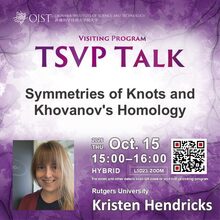
TSVP Talk: "Symmetries of Knots and Khovanov's Homology" by Kristen Hendricks
TSVP Talk Language: English (no interpretation). Target audience: General audience / everyone at OIST and beyond. Freely accessible to all OIST members and guests without registration (also via Zoom).
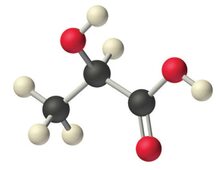
Mini Course: Practical Machine Learning for Polymer Chemistry
A mini course on the application of machine learning in polymer chemistry
Professor Rong Tong is Associate Professor in Chemical Engineering at Virginia Tech
5 lectures over 5 weeks. October 16 to November 13 (Friday afternoons)
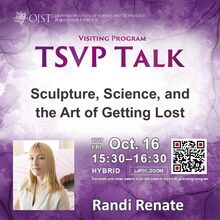
TSVP Talk: "Sculpture, Science, and the Art of Getting Lost" by Randi Renate
TSVP Talk Language: English (no interpretation). Target audience: General audience / everyone at OIST and beyond. Freely accessible to all OIST members and guests without registration (also via Zoom).
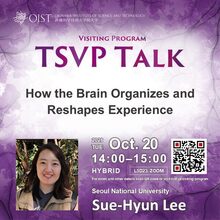
TSVP Talk: How the Brain Organizes and Reshapes Experience by Sue-Hyun Lee
TSVP Talk Language: English (no interpretation). Target audience: General audience / everyone at OIST and beyond. Freely accessible to all OIST members and guests without registration (also via Zoom).
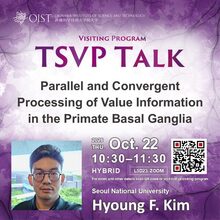
TSVP Talk: Parallel and Convergent Processing of Value Information in the Primate Basal Ganglia by Hyoung Kim
TSVP Talk Language: English (no interpretation). Target audience: General audience / everyone at OIST and beyond. Freely accessible to all OIST members and guests without registration (also via Zoom).
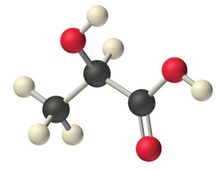
Mini Course: Practical Machine Learning for Polymer Chemistry 2
A mini course on the application of machine learning in polymer chemistry
Professor Rong Tong is Associate Professor in Chemical Engineering at Virginia Tech
5 lectures over 5 weeks. October 16 to November 13 (Friday afternoons)
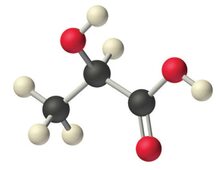
Mini Course: Practical Machine Learning for Polymer Chemistry 3
A mini course on the application of machine learning in polymer chemistry
Professor Rong Tong is Associate Professor in Chemical Engineering at Virginia Tech
5 lectures over 5 weeks. October 16 to November 13 (Friday afternoons)
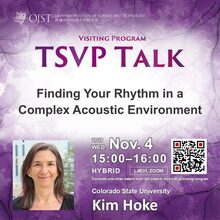
TSVP Talk: "Finding Your Rhythm in a Complex Acoustic Environment" by Kim Hoke
TSVP Talk Language: English (no interpretation). Target audience: General audience / everyone at OIST and beyond. Freely accessible to all OIST members and guests without registration (also via Zoom).