



Past Events
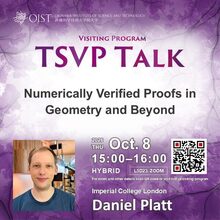
TSVP Talk: "Numerically Verified Proofs in Geometry and Beyond" by Daniel Platt
2026-10-08TSVP Talk
Language: English (no interpretation).
Target audience: General audience / everyone at OIST and beyond.
Freely accessible to all OIST members and guests without registration (also via Zoom).
Mini-Workshop on Gauge Theory and Low-Dimensional Topology
2026-10-07 to 2026-10-09The OIST Mini-Workshop on Gauge Theory and Low-Dimensional Topology is a three-day research meeting bringing together researchers working in gauge theory and low-dimensional topology.
The workshop is held as part of the OIST program New Frontiers in Gauge Theory, Topology, and Physics.

Coffee Hour at the Visiting Program
2026-10-05"Visiting Program Coffee Hour": informal discussions and getting to know each other, in the Visiting Program (TSVP) area in Lab 5 EF03

Workshop on "Gauge Theory and Mathematical Physics"
2026-10-05 to 2026-10-06This workshop is part of TSVP Thematic Program “New Frontiers in Gauge Theory, Topology, and Physics” (TP26GT) at Okinawa Institute of Science and Technology.

TSVP Talk: Why “Science education and public engagement” – and why at OIST? - by Liat Ben David
2026-09-30TSVP Talk
Language: English (no interpretation).
Target audience: General audience / everyone at OIST and beyond.
Freely accessible to all OIST members and guests without registration (also via Zoom).

Coffee Hour at the Visiting Program
2026-09-28"Visiting Program Coffee Hour": informal discussions and getting to know each other, in the Visiting Program (TSVP) area in Lab 5 EF03
[Seminar] "The Obstruction of Orientability of Real Monopole Floer Homology" by Jin Miyazawa
2026-09-24Title: The Obstruction of Orientability of Real Monopole Floer Homology
Abstract: The Real Seiberg-Witten theory is one of a stong tool in knot theory and surface knot theory. For example, that can detect exotic P^2-knot and Kang-Park-Taniguchi proved that any non trivial cable of figure eight knot is not slice using Real Seiberg-Witten theory. This theory is also provide interesting phenomena in index theory, since Real Seiberg-Witten theory can be seen as a "non-linear version" of Atiya's Real K-theory. For example, there is an obstruction to orient moduli space of Real Seiberg-Witten eqations on closed 4-manifolds. Recently, Bonciocat obtained a obstruction to lift the real Heegaard Floer homology from mod 2 coefficient to Z-coefficient. In this talk, we give a canonical way to obtain Z- coefficient real monopole Floer homology of double branced cover of a link in homology S^3 in the case when the obstruction vanishes. We also proved that the Bonciocat's obstruction is also obstract Z-coefficient in real monopole, however the proof is different. This is joint work with Jiakai Li.
[Seminar] "2-torsion in Instanton Homology" by Deeparaj Bhat
2026-09-16Title: 2-torsion in Instanton Homology
Abstract: This talk will focus on the presence of 2-torsion in a specific flavour of instanton (knot) homology introduced by Kronheimer--Mrowka. The main results are that the Poincaré homology sphere and fibered knots in 3-manifolds exhibit 2-torsion in their instanton homology. The key gauge theoretic input used in both results is a new surgery exact triangle, which relates instanton homology of three manifolds obtained by surgeries on a knot to singular instanton homology of the knot. Time permitting, we also sketch the use of sutured Floer theory in the second main result. Part of the talk is based on joint work with Zhenkun Li and Fan Ye.
[Seminar] "Signs in real monopole Floer homology" by Jiakai Li
2026-09-16Title: Signs in real monopole Floer homology
Abstract:
The computation of the 3-dimensional framed real Seiberg–Witten invariant of the branched double cover of a knot K is instrumental in Miyazawa's construction of exotic P^2-knots. This invariant, known as Miyazawa's degree invariant deg(K), is the Euler characteristic χ(HMR) of framed real monopole Floer homology (HMR). A priori deg(K) is defined only up to an overall sign, since the real Dirac operator has no complex orientation. Worse, signs associated to distinct real spin^c structures are not comparable. Resolving the latter issue is essential for developing computational techniques for real Seiberg--WItten invariants.
I will explain how to fix the sign of the 3-dimensional count, in other words, define an absolute mod-two grading, via a mod-two index-theoretic correction term. This yields a total Euler characteristic \tilde{χ} that sums over all real spin^c structures, the analogue of \hat{χ} in real Heegaard Floer homology (HFR). Recent work of Srivastava provides the motivating results: an absolute mod-two grading in \hat{HFR} and the evaluation of \hat{χ} in terms of the Alexander polynomial at \sqrt{-1}. This is joint work with Ciprian Manolescu.
[Seminar] "Peg problems and symplectic geometry" by Andrew Lobb
2026-09-15Title: Peg problems and symplectic geometry.
Abstract: The unsolved Toeplitz Square Peg Problem was posed in 1911. It asks whether all Jordan curves (subsets of the real plane homeomorphic to a circle) contain four points at the vertices of a square. We shall discuss this problem and related "peg" problems. They sometimes admit a description in terms of symplectic geometry.
No prior knowledge of pegs or of symplectic geometry assumed. (Joint work with Josh Greene).