



Past Events
[seminar] "Flexibility in Bacterial Replication Origins: Molecular Mechanisms and Evolutionary Implications" by Shogo Ozaki
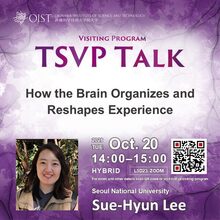
TSVP Talk: How the Brain Organizes and Reshapes Experience by Sue-Hyun Lee
TSVP Talk Language: English (no interpretation). Target audience: General audience / everyone at OIST and beyond. Freely accessible to all OIST members and guests without registration (also via Zoom).
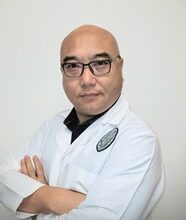
Seminar "Intelligent Biochips for Brain-Machine Interface" Prof. Chenzhong Li
Language: English
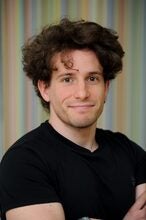
【Analysis and Partial Differential Equations Seminar】 Concentrations and singularities in PDEs
Seminar by Dr. Luca Gennaioli, University of Warwick
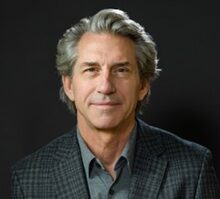
Presentation skill workshop 1: Short Talks & Elevator Speeches
Short Talks & Elevator Speeches
In this webinar, we will discuss the most important components of scientific storytelling, namely: how to make a talk focused and engaging; how to present the appropriate amount of data with appealing slide design; how to make the talk personal, memorable, and aid future collaborations - useful tool for conferences and proposals. The webinar is highly interactive so students should come prepared to share selective ideas of their work.
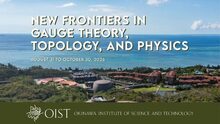
[Seminar] "Counting Tensor Invariants with Defect TQFT " by Michael Lathwood
Michael Lathwood (OIST): October 19, 4pm-5pm, lecture room L5D23.
Title: Counting Tensor Invariants with Defect TQFT
Abstract: A tensor transforming under a unitary-orthogonal symmetry group carries finitely many invariant observables of each degree. Counting these so-called tensor invariants is an important problem in the theory of tensor models, and it reduces to counting tuples of permutations modulo a conjugation action.
In this talk, I will explain how this counting can be interpreted as the partition function of an untwisted Dijkgraaf-Witten topological quantum field theory with defects. The permutations groups appearing in the tensor invariant counting problem are exactly the defect data of a stratified manifold, and the tensor invariant is then the groupoid cardinality of the associated gauge groupoid. I conclude with physics applications coming from this perspective of tensor invariants.
This talk is based on forthcoming joint work with Remi Cocou Avhou, Noan Botcazou-Brasse, and Reiko Toriumi.

Coffee Hour at the Visiting Program
"Visiting Program Coffee Hour": informal discussions and getting to know each other, in the Visiting Program (TSVP) area in Lab 5 EF03
Seminar "Development of novel electrochemical biosensor technologies and translation into products for use in the real world" Prof. Damion Corrigan
Language: English
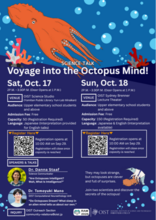
Voyage into the Octopus Mind
This science talk features an OIST researcher and a guest science communicator as they explore the mysteries of the octopus mind.
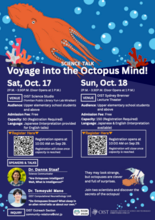
[RAM2026] Outreach Talk from Invited Guest Dr. Staaf and Dr. Mano: “Voyage Into The Octopus Mind” (Sydney Brenner Hall, OIST)
In this workshop, OIST researcher, Dr. Tomoyuki Mano, and guest science communicator, Dr. Danna Staaf, invite participants to explore the fascinating world of the octopus mind. Octopuses may look strange, but they are smart and full of surprises! Join our two speakers and discover the secrets of the octopus! Registration Required
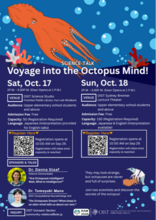
Voyage into the Octopus Mind
This science talk features an OIST researcher and a guest science communicator as they explore the mysteries of the octopus mind.
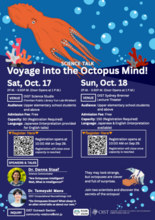
[RAM2026] Outreach Talk from Invited Guest Dr. Staaf and Dr. Mano: “Voyage Into The Octopus Mind” (Yomitan Library)
In this workshop, OIST researcher, Dr. Tomoyuki Mano, and guest science communicator, Dr. Danna Staaf, invite participants to explore the fascinating world of the octopus mind. Octopuses may look strange, but they are smart and full of surprises! Join our two speakers and discover the secrets of the octopus! Registration Required
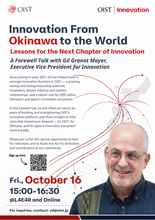
Innovation from Okinawa to the World: Lessons for the Next Chapter of Innovation ―A Farewell Talk with Gil Granot-Mayer-
Please join us to celebrate Gil, who has served as OIST's Executive Vice President for Innovation and Outreach, as he prepares to conclude his role at OIST at the end of October.
Mini Course: Practical Machine Learning for Polymer Chemistry
A mini course on the application of machine learning in polymer chemistry
Professor Rong Tong is Associate Professor in Chemical Engineering at Virginia Tech
5 lectures over 5 weeks. October 16 to November 13 (Friday afternoons)
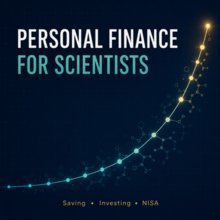
Mini Course: Personal Finance for Scientists in Japan
Introducing graduate students and postdoctoral researchers in Japan with some of the knowledge and tools needed to start thinking about and planning personal finances effectively.
Dr. Saahil Achariya is an OIST Graduate and now a post-doc in the Kusumi Unit
Four sessions over two Fridays, October 9 and 16 from 0900-1200 in L4E01
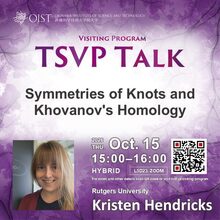
TSVP Talk: "Symmetries of Knots and Khovanov's Homology" by Kristen Hendricks
TSVP Talk Language: English (no interpretation). Target audience: General audience / everyone at OIST and beyond. Freely accessible to all OIST members and guests without registration (also via Zoom).
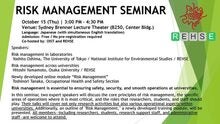
Risk Management Seminar
The seminar will focus on risk management, with invited external experts discussing risk management in research laboratories and across the university as a whole.
[Seminar] "From dislocation dynamics to Hamilton-Jacobi equations: homogenization and the Orowan mechanism" by Dr. Panrui Ni
Title: From dislocation dynamics to Hamilton-Jacobi equations: homogenization and the Orowan mechanism
Speaker: Dr. Panrui Ni (Waseda University)
Dynamics, Fluctuations, and Entanglement in Quantum Materials and Many-Body Systems
Dynamics, Fluctuations, and Entanglement in Quantum Materials and Many-Body Systems
OIST Representation Theory Seminar
[Seminar] "Universal Link Invariants via Configuration Spaces" by Cristina Ana-Maria Anghel
Cristina Ana-Maria Anghel (Université Clermont Auvergne): October 13, 4pm-5pm, lecture room L5D23 (online talk).
Title: Universal Link Invariants via Configuration Spaces
Abstract: Coloured Jones and Alexander polynomials are quantum invariants originating in representation theory and their geometric information is an important open problem in quantum topology. We present a new topological perspective that unifies these invariants through the topology of configuration spaces. First, for a fixed N, we define new link invariants: "N-th Unified Jones invariant" and "N-th Unified Alexander invariant" globalising all coloured Jones and ADO link polynomials of (multi)-colours bounded by N. Asymptotically, Habiro defined his universal knot invariant globalising coloured Jones polynomials by introducing the Habiro ring. For the link case, such globalisation remained open for both sequences of invariants. We answer this problem coming from representation theory using topological tools. On the representation theory side we define extensions of Habiro type rings. On the topological side, we construct a universal Jones link invariant and a universal Alexander link invariant. Putting these together, our universal invariants of geometrical nature take values in the extended Habiro rings that we construct.
[Seminar] Mr. Jonas Habel "Bloch Oscillations Revisited: Beyond Charge Transport"
Target audience: Interns, Students, PostDocs, and those who are interested in the same research field. Language: English
[Seminar] "Towards a Bogomolov-Miyaoka-Yau inequality for symplectic 4-manifolds, II" by Paul Feehan
Paul Feehan (Rutgers University): October 13, 2:30pm-3:30pm, lecture room L5D23.
Title: Towards a Bogomolov-Miyaoka-Yau inequality for symplectic 4-manifolds, II
Abstract: The Bogomolov-Miyaoka-Yau inequality for minimal compact complex surfaces of general type was proved in 1977 independently by Miyaoka, using methods of algebraic geometry, and by Yau, as an outgrowth of his proof of the Calabi conjectures. In this talk, we describe progress in our ongoing program to prove the conjecture that symplectic 4-manifolds obey the Bogomolov-Miyaoka-Yau inequality. Our program uses Morse theory on the gauge theoretic moduli space of non-Abelian monopoles, where the Morse function is a Hamiltonian for a natural circle action and natural two-form. We shall describe generalizations of Donaldson’s symplectic subspace criterion (1996) from finite to infinite dimensions and generalizations of Taubes' perturbation analysis from the Seiberg-Witten to non-Abelian monopole equations. These methods have application to the problem of showing that the fundamental two-form is non-degenerate and thus an almost symplectic form on the moduli space of non-Abelian monopoles. This talk is based on joint work with Tom Leness and the monographs https://arxiv.org/abs/2010.15789 (to appear in AMS Mathematical Surveys and Monographs), https://arxiv.org/abs/2206.14710 and https://arxiv.org/abs/2410.13809 .
[Seminar] From 2D Chips to 3D Brains
Seminar by Kwabena Boahen, Stanford University

Sports Fiesta
OIST Sports Fiesta 2026 is coming — our first community-wide day of sport, teams, food, music, and fun activities all to raise funds for new gym equipment. Held on National Sports Day: Monday Oct 12, 1–5 PM at Akama Sports Field, open to students, staff, faculty, and families (kids welcome!).

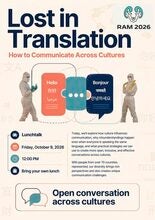
[RAM2026] “Lost in Translation: How to Communicate Openly Across Cultures”, DEI Lunch Seminar
Today, we'll explore how culture influences communication, why misunderstandings happen even when everyone is speaking the same language, and what practical strategies we can use to create more open, inclusive, and effective conversations across cultures.
Mini Course: Personal Finance for Scientists in Japan 2026
Introducing graduate students and postdoctoral researchers in Japan with some of the knowledge and tools needed to start thinking about and planning personal finances effectively.
Dr. Saahil Achariya is an OIST Graduate and now a post-doc in the Kusumi Unit
Four sessions over two Fridays, October 9 and 16 from 0900-1200 in L4E01
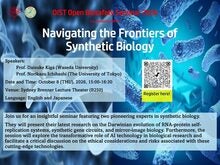
OIST Open Biosafety Seminar 2026 "Navigating the Frontiers of Synthetic Biology"
Latest research on the Darwinian evolution of RNA-protein self-replication systems, synthetic gene circuits, and mirror-image biology.
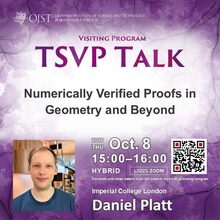
TSVP Talk: "Numerically Verified Proofs in Geometry and Beyond" by Daniel Platt
TSVP Talk Language: English (no interpretation). Target audience: General audience / everyone at OIST and beyond. Freely accessible to all OIST members and guests without registration (also via Zoom).
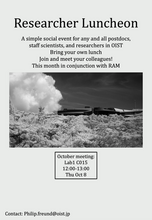
[RAM2026] Researchers Monthly Luncheon
Bring your own lunch and join us to make new connections and enjoy some fun conversations! This month in conjunction with RAM.

【October 7th】 Travel Consultation Session/ 【10/7】 旅費相談会
Travel Expense Team will hold a travel consultation session.
旅費相談会を開催いたします。
[Seminar] Development of Time-Resolved Fluorescence Spectroscopy Using Heralded Emission Spectroscopy for Organic Light-Emitting Materials
Dr Nicola J. Fairbairn, JSPS Postdoctoral Fellow at The University of Electro-Communications in Tokyo & University of Glasgow, UK
Mini-Workshop on Gauge Theory and Low-Dimensional Topology
The OIST Mini-Workshop on Gauge Theory and Low-Dimensional Topology is a three-day research meeting bringing together researchers working in gauge theory and low-dimensional topology.
The workshop is held as part of the OIST program New Frontiers in Gauge Theory, Topology, and Physics.
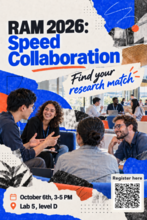
[RAM2026] Speed-collaboration event
This event will let you find colleagues at OIST with similar research interests and facilitate collaboration. We will gather people in the same broad research area to talk about their aspirations, technical challenges, and skills. You can walk out with helpful suggestions for your problems, and perhaps with a new collaborator. Registration link: Speed Collaboration Registration – Fill out form

Coffee Hour at the Visiting Program
"Visiting Program Coffee Hour": informal discussions and getting to know each other, in the Visiting Program (TSVP) area in Lab 5 EF03
Workshop on "Gauge Theory and Mathematical Physics"
This workshop is part of TSVP Thematic Program “New Frontiers in Gauge Theory, Topology, and Physics” (TP26GT) at Okinawa Institute of Science and Technology .
OIST NetCafé Online Information Session in English 2026 (English)
OIST NetCafé is a casual science information session to introduce the OIST PhD program, Research Internship, and other workshops. OIST members such as PhD students and admissions staff will meet you to answer all your questions!
Introduction to HPC and scientific computing - Session 2
A beginner's introduction to using the clusters and other computing resources at OIST. This is the second, hands-on session.
StrucShare Meeting:
StrucShare Meeting by Klemens Leo McJarrow Keller & Daniel Gutierrez Del Rio
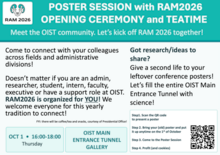
[RAM2026] Opening and OIST-wide Poster Session with Teatime
Start RAM 2026 celebration by presenting your research at the RAM Poster Session!
Introduction to the Command Line
The command line is the primary way to use the high performance computing resources at OIST. Here we quickly learn the basics we need to become comfortable and productive.
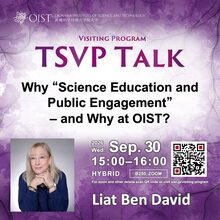
TSVP Talk: Why “Science education and public engagement” – and why at OIST? - by Liat Ben David
TSVP Talk Language: English (no interpretation). Target audience: General audience / everyone at OIST and beyond. Freely accessible to all OIST members and guests without registration (also via Zoom).
Storage at OIST
Reliable data storage is fundamental to research. In this training we will introduce the storage systems, talk about how to organise your data, do backups, handle remote data transfer, and the do’s and don’ts of using the storage systems.
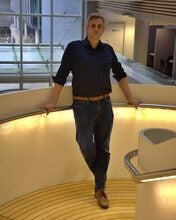
[Seminar] "Revealing the nature of black holes using the quantum nature of light"
Professor Matthew Middleton, Director of the Southampton Space Institute Deputy Head of School (Education), School of Physics and Astronomy University of Southampton

Introduction to HPC and scientific computing - Session 1
This training course will show you how to make best use of the high-performance computing resources at OIST. In the first session we show you how computing clusters are organized and introduce the fundamental concepts of parallel computing.
[Seminar - Cancelled] "Strong positivity property for subdiffusion equations and applications to related inverse problems" by Prof. Yikan Liu
Title: Strong positivity property for subdiffusion equations and applications to related inverse problems
Speaker: Prof. Yikan Liu (Kyoto University)
Coffee Hour at the Visiting Program
"Visiting Program Coffee Hour": informal discussions and getting to know each other, in the Visiting Program (TSVP) area in Lab 5 EF03
[Seminar - Cancelled] "From image generation to three-dimensional turbulence: a physically interpretable diffusion-model from the perspective of deterministic PDEs" by Prof. Tsuyoshi Yoneda
Title: From image generation to three-dimensional turbulence: a physically interpretable diffusion-model from the perspective of deterministic PDEs
Speaker: Prof. Tsuyoshi Yoneda (Hitotsubashi University)
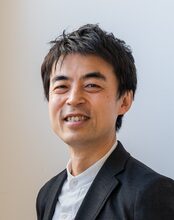
[Seminar] Remodeling of the Intracellular Physical Environment During Embryogenesis: From the Nucleus to the Cytoplasm by Prof. Akatsuki Kimura, National Institute of Genetics & SOKENDAI, Japan
Prof. Akatsuki Kimura, National Institute of Genetics & The Graduate University for Advanced Studies (SOKENDAI), Japan