



[Seminar] In-plane oscillations of a slack catenary using assumed modes by Prof.Anindya Chatterjee
Date
Location
Description
Title:
In-plane oscillations of a slack catenary using assumed modes.
Speaker:
Dr Anindya Chatterjee, Professor, Mechanical Engineering, IIT Kanpur
(collaborators: Bidhayak Goswami and Indrasis Chakraborty)
Abstract:
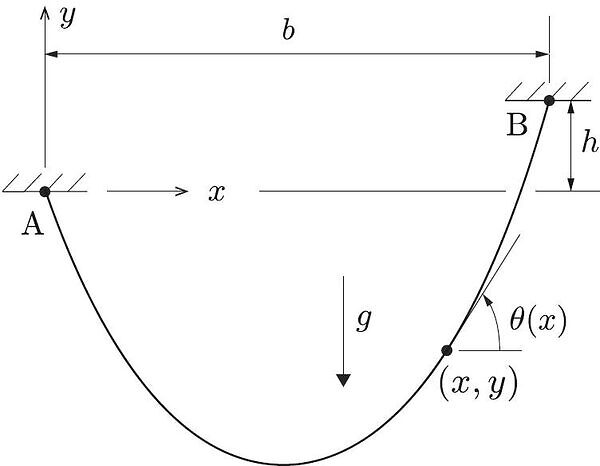
If we take a chain (inextensible, uniform mass per unit length, no bending rigidity, under gravity) and hang it in a slack configuration by fixing two endpoints, then the equilibrium shape is a catenary. This chain can have small in-plane oscillations about equilibrium, along normal modes with specific frequencies. Unlike many elementary vibration problems, however, there was until recently no assumed-modes solution for these vibration frequencies. This may be because the assumed modes need to satisfy the pointwise inextensibility constraint in the chain. I will describe such an assumed-modes solution. This seemingly simple problem in Lagrangian mechanics can be worked out on a computer within one lecture, yields insight into constraints in dynamics, and has an interesting final resolution.
Our approach is as follows. With endpoints fixed, the vertical (or y) displacement can be written using a truncated sine series (assumed-modes). Pointwise inextensibility yields derivatives of the horizontal (or x) displacement. Integrating from one end, we obtain the horizontal displacement along the chain, with a possibly-nonzero value at the distal end. We therefore add a scalar constraint for the horizontal displacement at the end. Interestingly, the potential energy is strictly linear in the generalized coordinates, and does not directly yield oscillations. Lagrange’s equations, however, yield an inhomogeneous linear system of ODEs. Since zero displacement represents equilibrium, the inhomogeneous terms must cancel out: this makes the Lagrange multiplier determinate, yielding a routine eigenvalue problem for natural frequencies and mode shapes. Interestingly, if we take these same mode shapes as our assumed modes from the start, then the inhomogeneous terms drop out automatically and the Lagrange multiplier remains indeterminate. Finally, adding a tiny indeterminate constraint-preserving perturbation to one such mode shape allows elimination of the constraint and adds a quadratic effective potential energy, with subsequent analysis being that of any spring-mass oscillator. In these ways, this problem takes up a classical problem, presents an unconventional solution approach, yields insights into the role of constraints, and presents a final satisfactory puzzle wherein using an exact solution makes solution more difficult but, in the end, yields a simple harmonic oscillator.
Zoom:
Meeting URL: https://oist.zoom.us/j/97546732590?pwd=6zbCcFR3GPWzBIHqXGxETOFEyR7bNB.1&from=addon
Meeting ID: 975 4673 2590
Passcode: 481164
Subscribe to the OIST Calendar: Right-click to download, then open in your calendar application.