



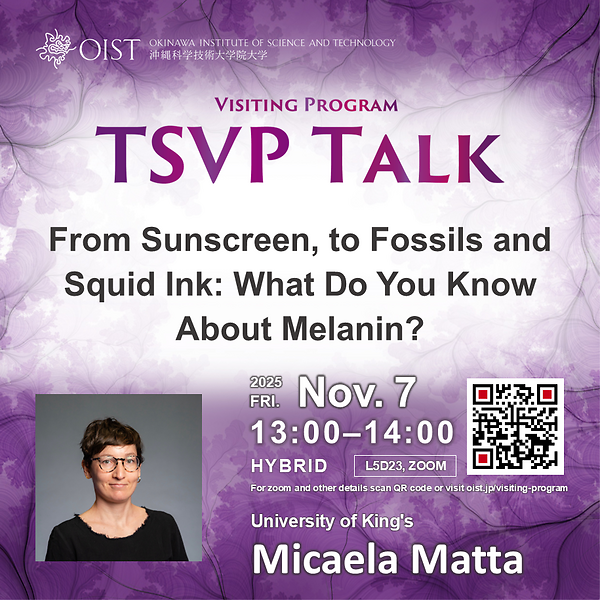
TSVP Talk: "From Sunscreen, to Fossils and Squid Ink: What Do You Know About Melanin?" by Micaela Matta
Date
Location
Description
Title: From Sunscreen, to Fossils and Squid Ink: What Do You Know About Melanin?
Speaker: Micaela Matta, Faculty of Natural, Mathematical & Engineering Sciences, King's College London
Abstract: What do humans, insects, fungi have in common? They have evolved to use melanin for pigmentation and to protect themselves from the harmful effects of solar radiation. Specifically, all these organisms can produce eumelanin (the black-brown pigment in our eyes, hair and skin). Surprisingly for a material so common, we know very little about the chemical structure of melanin. Although we have advanced knowledge on the shape and function of DNA or proteins, the mechanism behind our natural sunscreen remains a mystery. Understanding melanins is tricky because they are very heterogeneous, or ‘messy’, biopolymers: they are formed by a collection of different ‘building blocks’, which may be linked together in a myriad different ways, leading to a combinatorial explosion of structures. This talk will outline recent advances in our understanding of melanin’s structure and properties, and the development of melanin-inspired technologies.Due to its ability to absorb UV light, melanin is also being explored as a shield for healthy tissue during cancer therapy as well as in spacecraft coatings. Synthetic (lab-made) melanin is being used to develop environmentally friendly paints and coatings. Engineered microorganisms or food waste could be a source of low-cost melanin in the future. There are only a handful of UV-protecting molecules suitable for use in sunscreens, and developing new ‘sunscreen chemicals’ is extremely difficult. Understanding the mechanism behind melanin's natural sunblock can lead to the development of completely new, melanin-inspired sunscreens that are non-toxic, biodegradable and environmentally friendly.
Profile: Dr Micaela Matta is a Lecturer in Computational Materials Chemistry in the Department of Chemistry, King's College London. She obtained her master's and PhD at the University of Bologna, and held postdoctoral appointments at the University of Bordeaux and Northwestern University. In 2019, she joined the University of Liverpool as the awardee of a Royal Society Newton International Fellowship and a Marie Curie Individual Fellowship.
Language: English
Target audience: General audience/everyone at OIST and beyond.
Freely accessible to all OIST members and guests without registration.
This talk will also be broadcast online via Zoom:
Meeting ID: 974 6485 2241
Passcode: 399437
※ Please note that this event may be recorded and the videos uploaded. In addition, photos may be taken during the event. These are intended for publication online (the OIST website, social media, etc.)※
Attachments

Subscribe to the OIST Calendar: Right-click to download, then open in your calendar application.