



今後のイベント
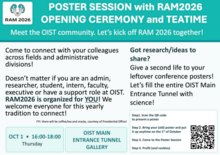
Call for RAM2026 Posters
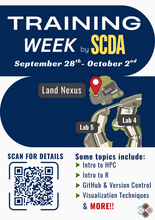
SCDA Training Week
The Scientific Computing & Data Analysis Section (SCDA) invites you to a full week of training to get your computing set up and your questions answered!
Scan the QR code for the full schedule!
Storage at OIST
Reliable data storage is fundamental to research. In this training we will introduce the storage systems, talk about how to organise your data, do backups, handle remote data transfer, and the do’s and don’ts of using the storage systems.
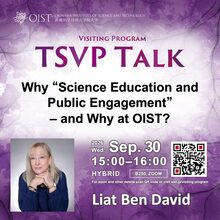
TSVP Talk: Why “Science education and public engagement” – and why at OIST? - by Liat Ben David
TSVP Talk Language: English (no interpretation). Target audience: General audience / everyone at OIST and beyond. Freely accessible to all OIST members and guests without registration (also via Zoom).
Introduction to the Command Line
The command line is the primary way to use the high performance computing resources at OIST. Here we quickly learn the basics we need to become comfortable and productive.
StrucShare Meeting:
StrucShare Meeting by Klemens Leo McJarrow Keller & Daniel Gutierrez Del Rio
Introduction to HPC and scientific computing - Session 2
A beginner's introduction to using the clusters and other computing resources at OIST. This is the second, hands-on session.
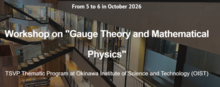
Workshop on "Gauge Theory and Mathematical Physics"
This workshop is part of TSVP Thematic Program “New Frontiers in Gauge Theory, Topology, and Physics” (TP26GT) at Okinawa Institute of Science and Technology .
Mini-Workshop on Gauge Theory and Low-Dimensional Topology
The OIST Mini-Workshop on Gauge Theory and Low-Dimensional Topology is a three-day research meeting bringing together researchers working in gauge theory and low-dimensional topology.
The workshop is held as part of the OIST program New Frontiers in Gauge Theory, Topology, and Physics.
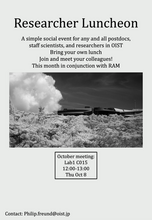
Researchers Monthly Luncheon
Bring your own lunch and join us to make new connections and enjoy some fun conversations! This month in conjunction with RAM.
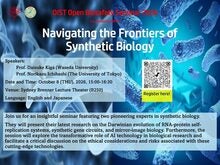
OIST Open Biosafety Seminar 2026 "Navigating the Frontiers of Synthetic Biology"
Latest research on the Darwinian evolution of RNA-protein self-replication systems, synthetic gene circuits, and mirror-image biology.
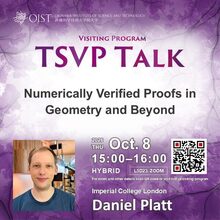
TSVP Talk: "Numerically Verified Proofs in Geometry and Beyond" by Daniel Platt
TSVP Talk Language: English (no interpretation). Target audience: General audience / everyone at OIST and beyond. Freely accessible to all OIST members and guests without registration (also via Zoom).
DEI Lunch Seminar
DEI Lunch Seminar: open communication across cultures. Details to be added later
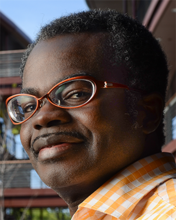
[Seminar] From 2D Chips to 3D Brains
Seminar by Kwabena Boahen, Stanford University
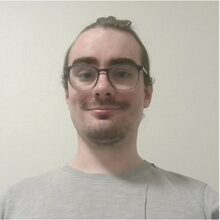
[Seminar] Mr. Jonas Habel "Bloch Oscillations Revisited: Beyond Charge Transport"
Target audience: Interns, Students, PostDocs, and those who are interested in the same research field. Language: English
Dynamics, Fluctuations, and Entanglement in Quantum Materials and Many-Body Systems
Dynamics, Fluctuations, and Entanglement in Quantum Materials and Many-Body Systems
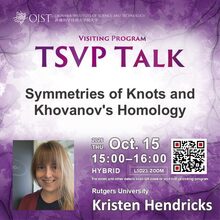
TSVP Talk: "Symmetries of Knots and Khovanov's Homology" by Kristen Hendricks
TSVP Talk Language: English (no interpretation). Target audience: General audience / everyone at OIST and beyond. Freely accessible to all OIST members and guests without registration (also via Zoom).
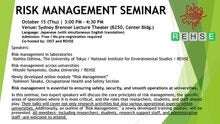
Risk Management Seminar
The seminar will focus on risk management, with invited external experts discussing risk management in research laboratories and across the university as a whole.
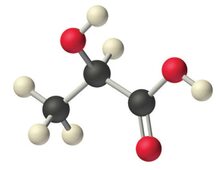
Mini Course: Practical Machine Learning for Polymer Chemistry
A mini course on the application of machine learning in polymer chemistry
Professor Rong Tong is Associate Professor in Chemical Engineering at Virginia Tech
5 lectures over 5 weeks. October 16 to November 13 (Friday afternoons)

EMBO Workshop on Axonal Degeneration and Regeneration
OIST Workshop | Website | Main organizer: Marco Terenzio (Molecular Neuroscience Unit) |OIST members are welcome to attend all scientific sessions. Meals are closed sessions for registered participants only.
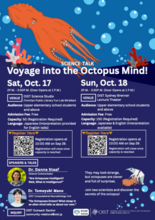
SCIENCE TALK: Voyage into the Octopus Mind!
In this workshop, OIST researcher, Dr. Tomoyuki Mano, and guest science communicator, Dr. Danna Staaf, invite participants to explore the fascinating world of the octopus mind. Octopuses may look strange, but they are smart and full of surprises! Join our two speakers and discover the secrets of the octopus! Registration Required
Seminar "Development of novel electrochemical biosensor technologies and translation into products for use in the real world" Prof. Damion Corrigan
Language: English
Seminar "Intelligent Biochips for Brain-Machine Interface" Prof. Chenzhong Li
Language: English
[seminar] "Flexibility in Bacterial Replication Origins: Molecular Mechanisms and Evolutionary Implications" by Shogo Ozaki

Monthly Co-working by The Bioinformatics User Group
Monthly Co-working space - by Bioinformatics User Group
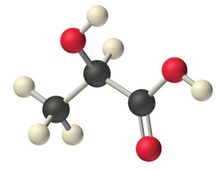
Mini Course: Practical Machine Learning for Polymer Chemistry 2
A mini course on the application of machine learning in polymer chemistry
Professor Rong Tong is Associate Professor in Chemical Engineering at Virginia Tech
5 lectures over 5 weeks. October 16 to November 13 (Friday afternoons)
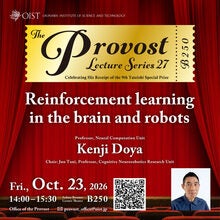
The Provost Lecture Series 27
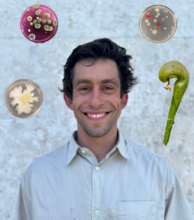
[Seminar] Asa Conover "Leveraging microbial interactions to shape microbiome composition and function"
Seminar by JSPS Fellow: Asa Conover
Mini Course: Practical Machine Learning for Polymer Chemistry 3
A mini course on the application of machine learning in polymer chemistry
Professor Rong Tong is Associate Professor in Chemical Engineering at Virginia Tech
5 lectures over 5 weeks. October 16 to November 13 (Friday afternoons)
Mini Course: Practical Machine Learning for Polymer Chemistry 4
A mini course on the application of machine learning in polymer chemistry
Professor Rong Tong is Associate Professor in Chemical Engineering at Virginia Tech
5 lectures over 5 weeks. October 16 to November 13 (Friday afternoons)
[Seminar] Catalytic Direct Synthesis of Primary Amines from Ammonium Salts: Protecting Groups as Catalysts. By Prof. Takashi Ohshima
Prof. Takashi Ohshima, Professor. Graduate School of Pharmaceutical Sciences, Kyushu University. Language: English
International Conference on Embodied Cognitive Science (ECogS 2026)
OIST Workshop | Website | Main organizer: Tom Froese (Embodied Cognitive Science Unit) | OIST members are welcome to attend all scientific sessions (registration required).
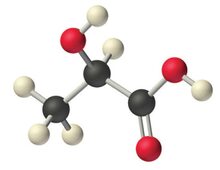
Mini Course: Practical Machine Learning for Polymer Chemistry 5
A mini course on the application of machine learning in polymer chemistry
Professor Rong Tong is Associate Professor in Chemical Engineering at Virginia Tech
5 lectures over 5 weeks. October 16 to November 13 (Friday afternoons)
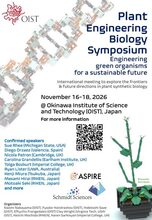
Plant Engineering Biology: Engineering green organisms for a sustainable future
Plant Engineering Biology: Engineering green organisms for a sustainable future
[Seminar] Dr. Florian Gabriel "Structural basis of substrate transport and drug recognition by the human thiamine transporter SLC19A3"
Seminar by Dr. Florian Gabriel from Centre for Structural Systems Biology (CSSB)
Seminar "Survival of Localized Turbulence in Wall-Bounded Flows" by Prof. Takahiro Tsukahara
[Speaker] Prof. Takahiro Tsukahara, Professor, Department of Mechanical and Aerospace Engineering, Tokyo University of Science

Bridging Theoretical and Experimental Frontiers in Quantum Materials
OIST Workshop | Website | Main organizer: Shu Zhang (Collective Dynamics and Quantum Transport Unit) |OIST members are welcome to attend all scientific sessions. Meals are closed sessions for registered participants only.
2027 MRI Workshop : From Image Acquisition to Analysis
Save the date: a hands-on MRI workshop for life scientists, 27-28 January 2027.
Details to follow.

Machine Learning Summer School 2027
OIST Workshop | Website | Main organizer: Makoto Yamada (Machine Learning and Data Science Unit) |OIST members are welcome to attend all scientific sessions. Meals are closed sessions for registered participants only.

Affine algebras and representation theory
OIST Workshop | Website | Main organizer: Tomoyuki Arakawa (Chiral Representation Theory Unit) |OIST members are welcome to attend all scientific sessions. Meals are closed sessions for registered participants only.

Major transitions in Life and Evolution: Crossing Boundaries in Living Systems
OIST Workshop | Website | Main organizer: Fumiaki Yokoyama (Buribushi Fellow; Yokoyama Group) |OIST members are welcome to attend all scientific sessions. Meals are closed sessions for registered participants only.