



[Seminar] Exploring the structural concepts of flextegrity and sheartegrity by Prof. Claudio Boni
Date
Location
Description
Abstract:
The terms “flextegrity” and “sheartegrity” were coined, drawing inspiration from the portmanteau “tensegrity” introduced by B. Fuller. The concept is represented by segments in unilateral contact on profiled surfaces and, as in Fuller’s tensegrities, tensile members keep the segments together and provide integrity to the system under external loads. The key aspect is that the nonlinear structural response is dictated by the geometry of the contact surfaces.
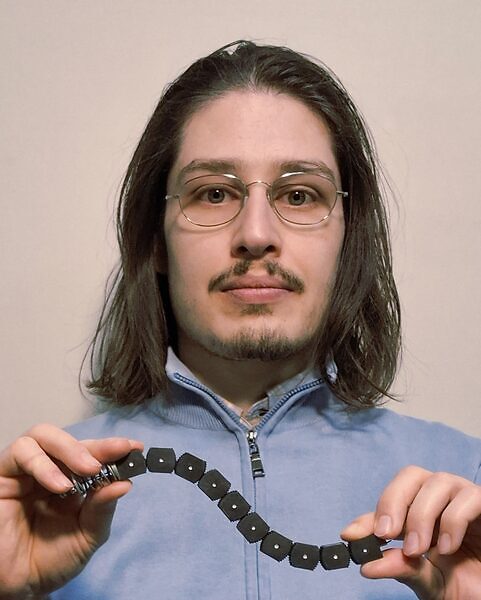
Flextegrity has its archetype in segmental beams in which stiff, pierced segments, possibly organized in a spatial assemblage, are held together by the tying action of a prestressed tendon passing through them, so that integrity under flexure is provided by the tendon. Since the segments can move relative to each other in pure rolling on tailor-shaped contact surfaces, the geometry dictates the constitutive response under bending. Moreover, by changing the allowed mobility of the tendon inside the segments (tubular sheath or larger cavities), it is possible to obtain a wide range of structural responses, including multi-stable joints and beams that snap as a whole between two distant configurations. The governing equations are found via a variational approach, and the theory is validated through experiments on 3D-printed prototypes. Applications of the concept to robotics, architecture and propulsion in fluids are envisaged.
Sheartegrity refers to complementary kinematics: moving from rolling to sliding, the segments, stacked in a brickwork pattern, are in cohesive-frictional contact on initially matching wavy surfaces. Elastic (prestressed) fibrils bridge the segments and oppose their mutual separation. As sliding occurs, inelastic stress-strain paths are observed, whose nonlinear trend is again governed by the geometry of the contact profiles. The model has been applied to interpret the mechanical behavior of nacre-like laminates, and as a phenomenological model for the tensile response of carbon-nanotube fibers. It may also inspire the design of metamaterials with tailored nonlinear response.
Bio:
Claudio Boni is Assistant Professor of Solid and Structural Mechanics at the University of Genoa (Department of Civil, Chemical and Environmental Engineering, DICCA), where he has been since 2024. He received his PhD in Industrial Engineering from the University of Parma in 2023, with a thesis on flexural tensegrity that was awarded the 2023 Best PhD Thesis in Mechanics of Materials by the GMA-AIMETA group. His research concerns the nonlinear mechanics of structures whose response is governed by the geometry of contact surfaces, including flextegrity and sheartegrity, with applications ranging from snapping beams for bio-inspired propulsion in fluids to nacre-like laminates and carbon-nanotube fibers. He has also worked on masonry structures, cables and everting kaleidocycles, and is currently working on lattice metamaterials.
Subscribe to the OIST Calendar: Right-click to download, then open in your calendar application.