



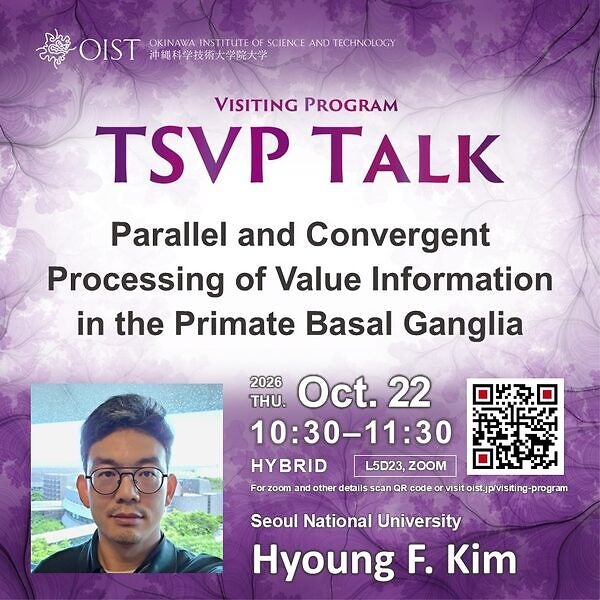
TSVP Talk: Parallel and Convergent Processing of Value Information in the Primate Basal Ganglia by Hyoung Kim
Date
Location
Description
Title: Parallel and Convergent Processing of Value Information in the Primate Basal Ganglia
Speaker: Hyoung F. Kim
Abstract: Primates possess specialized neural circuits that support efficient value-guided behavior. Here, I focus on two organizational principles of the primate basal ganglia: parallel processing for cognitive flexibility and habitual stability, and convergent processing of value information across sensory modalities. Flexible and stable object values are processed in parallel along the rostral–caudal axis of the basal ganglia. Rostral circuits support flexible updating of object values, whereas caudal circuits maintain stable, long-term values that guide habitual behavior. Beyond this parallel organization, primates integrate value information across sensory modalities, including vision and fingertip touch. We show that striatal neurons encode tactile value and that visual and tactile value signals converge at the single-neuron level, providing an efficient substrate for value abstraction. Despite this convergence, population activity retains sensory modality information, while greater similarity of value representations across modalities is associated with better decision-making performance. Together, these findings reveal parallel specialization and multimodal convergence as complementary principles of value processing in the primate basal ganglia.
Profile: Hyoung F. Kim is an Associate Professor in the School of Biological Sciences at Seoul National University, where he leads the Cognitive Circuitry Laboratory. He studies the neural circuit mechanisms underlying value-based decision-making in primates, with a particular focus on the basal ganglia. He is particularly interested in how parallel neural circuits support cognitive flexibility and habitual stability, and how neuronal populations integrate sensory and value information for efficient decision-making. He received his undergraduate degree in Biotechnology from the College of Engineering at Yonsei University and his PhD from Seoul National University under the mentorship of Dr. Bong-Kiun Kaang, studying transcriptional mechanisms underlying long-term memory. He subsequently conducted postdoctoral research with Dr. Okihide Hikosaka at the National Institutes of Health, investigating the neural mechanisms of value process in primates.
Language: English
Target audience: General audience/everyone at OIST and beyond.
Freely accessible to all OIST members and guests without registration.
This talk will also be broadcast online via Zoom:
Meeting ID: 993 1216 5065
Passcode: 603487
※ Please note that this event may be recorded and the videos uploaded. In addition, photos may be taken during the event. These are intended for publication online (the OIST website, social media, etc.)※
Attachments

Subscribe to the OIST Calendar: Right-click to download, then open in your calendar application.