



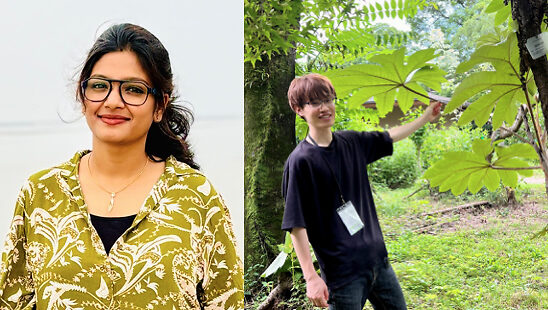
Seminar by Dr. Poulami Chatterjee (Presidency University) and Dr. Masayuki Shiba (Tokyo City University)
Date
Location
Description
14:00 - 14:40 [Talk 1] Speaker: Dr. Poulami Chatterjee (Presidency University)
Title: Actin-Binding Proteins and Canonical Wingless Signalling in Drosophila Egg Morphogenesis
Abstract
Epithelial morphogenesis is a highly coordinated process governed by cytoskeletal dynamics and signalling pathways. Using the Drosophila egg chamber as a model, this study investigates how actin-binding proteins and canonical Wingless Signalling regulate egg shape and border cell migration. Through a targeted genetic screen, key actin regulators, including components of the Arp2/3 complex, were identified as critical for maintaining proper actin organisation and egg chamber morphology. Disruption of these factors leads to altered egg shape, disruptive follicle cell behaviour, and impaired migration. Additionally, canonical Wingless Signalling emerges as an important regulator of egg morphogenesis, revealing novel genetic interactions with other pathways. Together, these findings highlight how cytoskeletal architecture and signalling networks work in concert to shape epithelial tissues.
Short Bio
Dr. Poulami Chatterjee is a researcher in Cellular and Developmental Biology. After completing her Master’s from the University of Calcutta, she joined as a CSIR-UGC fellow at Presidency University, Kolkata, from where she received her PhD in Life Sciences. Her work focuses on epithelial morphogenesis, with particular emphasis on cytoskeletal dynamics and collective cell migration using Drosophila as a model organism. Her research aims to elucidate how actin-binding proteins and key signalling pathways coordinate tissue architecture and cellular behaviour during development.
14:40 - 15:30 [Talk 2] Speaker: Dr. Masayuki Shiba (Tokyo City University)
Title: Adaptive strategies in petioles and stipes of rheophytic Osmunda lancea to mechanical stress
Abstract
Riparian plants, including rheophytes, are exposed to strong mechanical stress caused by water flow, particularly during sudden flooding events. Understanding how plants maintain structural integrity under such dynamic conditions is a key challenge for understanding adaptive strategies and their diversity in response to mechanical stress.
In this study, I investigate the rheophytic fern Osmunda lancea, which grows along riversides and experiences intense water flow stress. I focus on both sterile (vegetative) and fertile (reproductive) fronds, integrating previous findings on sterile fronds with new analyses of fertile fronds. To clarify the adaptive significance of these traits, I conducted combined morphoanatomical and mechanical analyses and compared both frond types with those of the closely related inland species O. japonica.
Mechanical analyses revealed that both sterile and fertile fronds of O. lancea exhibit enhanced flexibility compared to O. japonica, despite their contrasting functions and lifespans. Anatomical observations showed that this flexibility is associated with modifications in sclerenchyma cell structure, including reduced cell length and differences in cell wall organization. Shortened cell length increases the number of cells per unit length and, consequently, the number of cell–cell interfaces.
Based on these observations, we propose that intercellular slip at these interfaces functions as a movable component, and that the accumulation of displacement across many such interfaces contributes to the high flexibility of the petiole. In contrast, although fertile fronds also exhibit flexibility, the underlying mechanism appears to differ from that of sterile fronds. Because fertile fronds have a short aboveground lifespan, cell wall development is relatively limited. As a result, deformation of individual cells (cell deformation), rather than intercellular slip, likely plays a major role in generating flexibility in the petiole.
Short Bio
Masayuki Shiba is a postdoctoral researcher at Tokyo City University, Japan. Their research focuses on plant biomechanics and ecological morphology, with particular emphasis on how plants adapt their structure to environmental mechanical stress.
They study the relationships between cellular structure and organ-level mechanics using morphoanatomical and mechanical approaches. Their work aims to understand adaptive strategies of plants in dynamic environments, including riparian, coastal and serpentine habitats.
Zoom link https://oist.zoom.us/j/91494977857?pwd=RDQDuPHg9voMcufwJI2RTFJqePPa3p.1
Meeting ID: 914 9497 7857
Passcode: 398266
Subscribe to the OIST Calendar: Right-click to download, then open in your calendar application.