



Seminar"Angular Velocity of Kolmogorov-Scale Fibers as Proxy for Turbulent Dissipation" by Prof. Alfredo Soldati
Date
Location
Description
Speaker
Prof. Alfredo Soldati
Professor, Institute of Fluid Mechanics & Heat Transfer, TU Wien, Austria / Dept. Eng. & Arch., University of Udine, Udine, Italy
Abstract
IThe mean rate at which viscosity dissipates turbulent kinetic energy into heat is a key quantity in turbulence theory and modeling, yet its experimental determination remains challenging. Since the dissipation rate depends on the local velocity gradient tensor, and elongated fibers at the Kolmogorov scale respond sensitively to this tensor, their rotational dynamics can provide a direct probe of smallscale turbulence. Owing to their tendency to align with vorticity, the angular velocities of such fibers encode information on the local strain and rotation fields.
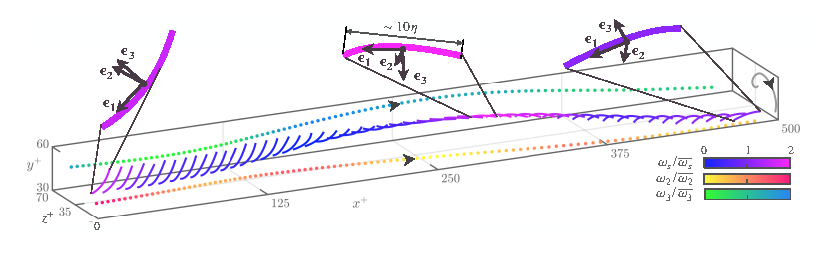
In this seminar, we review the dynamics of anisotropic particles in turbulence and present recent experiments in the TU Wien Turbulent Water Channel. Using elongated, mildly curved fibers with lengths slightly exceeding the Kolmogorov scale, we perform fully Lagrangian optical measurements of their spinning and tumbling rates. The fibers slight curvature enables unique 3D orientation tracking, yielding homogeneous datasets of full rotation dynamics.
Combining these measurements with direct numerical simulations employing point-wise fiber models, we demonstrate that the mean-square angular velocity of Kolmogorov-scale fibers provides an accurate proxy for the mean turbulent energy dissipation rate. Across a range of shear Reynolds numbers, short fibers are robust experimental tools for quantifying dissipation in turbulent flows. These findings also have implications for modeling the transport and sedimentation of anisotropic microplastics in aquatic environments.
References
[1] V. Giurgiu, G. Caridi, M. Alipour, M. De Paoli, and A Soldati Rev. Sci. Instrum. 94, 095101 (2023).
[2] S. Brizzolara, M.E. Rosti, S. Olivieri, L. Brandt, M. Holzner, A. Mazzino, Phys. Rev. X 11, 031060 (2021).
[3] V. Giurgiu, G. Caridi, M. Alipour, M. De Paoli, and A Soldati, Rev. Sci. Instrum. 94, 095101 (2023).
Subscribe to the OIST Calendar: Right-click to download, then open in your calendar application.