



Seminar "Mangroves… from text mentions in ancient times to biomes in modern open-world games"
Date
Location
Description
【Hosted by Dr. Matin Miryeganeh】
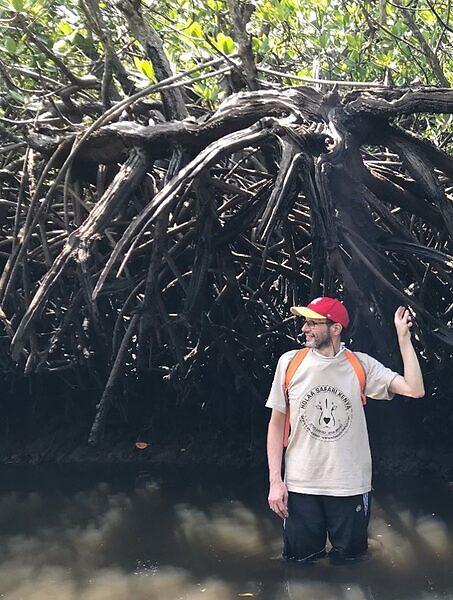
Title: Mangroves… from text mentions in ancient times to biomes in modern open-world games
Speaker: Prof. Farid DAHDOUH-GUEBAS,Vrije Universiteit Brussel
Summary:
Mangrove social-ecological systems being inherently diverse in composition of species, functions, services, and communities, this presentation exemplifies a transdisciplinary approach to understand, manage and popularise them
Abstract:
Understanding and predicting the spatio-temporal dynamics of vegetation and landscapes requires a retrospective approach, drawing on methods from various disciplines. We exemplify how including tropical botany, very high-resolution sequential remote sensing combined with ground-truthing, socio-ecological and ethnobiological surveys, and historical archive research followed by integrative analyses, such as geographic information systems (GIS), social surveys and discourse and social network analysis, can generate insights that are relevant both for advancing fundamental understanding of ecosystem functioning (e.g. health status, connectivity, resilience) and for informing ecosystem management (e.g., conservation, restoration, governance). More in particular we aim at building capacity and resilience for mangrove social-ecological systems in an era of change and uncertainty.
Within this framework, we place particular emphasis on biodiversity change, climate change, ecological and ethological plant-animal interactions, and human-ecosystem relationships. A key focus is on developing early warning systems for ecological degradation, unsustainable exploitation practices, and traditional ecological knowledge. We also investigate how conservation is communicated and perceived by the public, addressed in education, and integrated into the science-policy interface. This involves not only scientific publications, but also storytelling, social media analyses,
Historically, mangrove forests have served as a central model for our research. Our research spans multiple spatial scales, from localized case studies in various countries (from west to east: Mexico, Honduras, Cuba, Jamaica, Martinique, Guadeloupe, Colombia, Ecuador, Brazil, Mauritania, Senegal, The Gambia, Ghana, Guinea-Bissau, Guinea, Benin, Togo, Nigeria, Cameroon, RD Congo, South-Africa, Tanzania, Kenya, Madagascar, India, Sri Lanka, Bangladesh, Thailand, Malaysia, Singapore, Vietnam, China, Philippines) to global macroecological analyses. The research is often conducted jointly with international partners and stakeholders from all sectors of society, including research institutions, the corporate sector, international organizations, citizen science initiatives, governmental bodies, and NGOs. We also integrate these partners in joint master programmes such as the Erasmus Mundus Joint Master in Tropical Biodiversity and Ecosystems (www.tropimundo.eu). The presentation ends with an overview of scholarship opportunities in this discipline.
Bio : Farid DAHDOUH-GUEBAS leads the Systems Ecology and Resource Management research unit, which aims to understand and predict the spatio-temporal dynamics of mangrove social-ecological systems, often adopting a retrospective and transdisciplinary approach including ecology, geography, ethnobiology, and history. Integrative analyses generate insights that are relevant for advancing understanding ecosystems (e.g. health status, connectivity, resilience) and for informing ecosystem management (e.g., conservation, restoration, governance). A key focus is on developing early warning systems for loss ecosystem services and of traditional ecological knowledge. The research is often conducted jointly with international partners and stakeholders from all sectors of society, including research institutions, the corporate sector, international organizations, citizen science initiatives, governmental bodies, and NGOs. Together, we also investigate how conservation is perceived by the public, addressed in education, and integrated into the science-policy interface. Farid has 250+ peer-reviewed publications in this field and is also the Founding and managing Director of the Erasmus Mundus Joint Master in Tropical Biodiversity and Ecosystems (www.tropimundo.eu).
Subscribe to the OIST Calendar: Right-click to download, then open in your calendar application.