



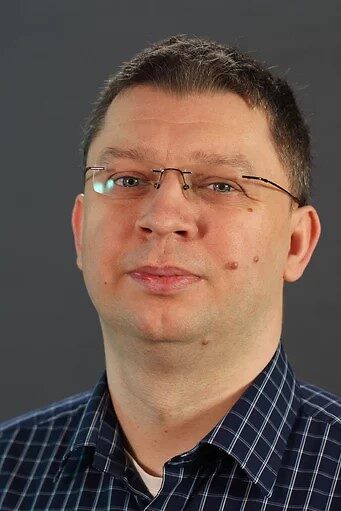
[Seminar] "2 - Dimensional Hybrid Perovskite as a Promising Semiconductor for Large Area Electronics" by Dr. Tomasz Marszalek
Date
Location
Description
2 - Dimensional Hybrid Perovskite as a Promising Semiconductor for Large Area Electronics
Tomasz Marszalek, PhD, Group Leader at Max Planck Institute for Polymer Research & Lodz University of Technology
Abstract: The functionality of organic-inorganic perovskites in large area electronics depends on the quality of the molecular organization and thin film morphology. Therefore, control of nucleation and growth is important to reduce structural defects and domain boundaries in the perovskite film to ensure unhindered carrier transport and high device performance. Grain engineering controlled by film deposition parameters and the chemical structure of organic cations are novel approaches to improve charge carrier transport and understand the relationship between crystallization and ions migration. First, a hot casting method to effectively modulate grain size and grain boundary number to improve in-plane carrier transport in perovskite films is discussed. Based on the obtained results a close correlation between grain boundary density, carrier transport and ion migration will be presented.[1] Secondly, a distinct odd-even effect in 2D Sn-based perovskite semiconductors is presented for the first time by incorporating phenylalkylammonium-based organic cations with different alkyl side chain lengths with odd and even carbon atoms.[2, 3] An odd-even oscillation of the charge carrier transport is revealed by optically pumped terahertz spectroscopy and transistor devices. Combining density functional theory calculations and simulated grazing-incidence wide-angle X-ray scattering, we show that the organic ligands with odd carbon atoms are featured with disordered crystal lattice and tilted inorganic octahedron leading to larger effective mass and thus inferior charge mobilities compared to the perovskites with an even carbon number of the organic cations.
【References】
[1] S. Wang, S. Frisch, H. Zhang, O. Yildiz, M. Mandal, N.Ugur, B. Jeong, C. Ramanan, D. Andrienko, H. I. Wang, M. Bonn, P. W. M. Blom, M. Kivala, W. Pisula and T. Marszalek, „Grain Engineering for Improved Charge Carrier Transport in Two-Dimensional Lead-Free Perovskite Field-Effect Transistors“, Mater. Horiz., 2022, 9, 2633
[2] S. Wang, S. Kalyanasundaram, L. Gao, Z. Ling, Z. Zhou, M. Bonn, P. W. M. Blom, H. I. Wang, W. Pisula, T. Marszalek, „Unveiling the role of linear alkyl organic cations in 2D layered tin halide perovskite field-effect transistors“, Mater. Horiz., 2024,11, 1177-1187
[3] S. Wang, M. Mandal, H. Zhang, D. W. Breiby, O. Yildiz, Z. Ling, G. Floudas, M. Bonn, D. Andrienko, H. I. Wang, P. W. M. Blom, W. Pisula, T. Marszalek, „Odd−Even Alkyl Chain Effects on the Structure and Charge Carrier Transport of Two-Dimensional Sn-Based Perovskite Semiconductors“, J. Am. Chem. Soc. 2024, 146, 19128−19136
Biography: Dr. hab. eng. Tomasz Marszalek studied Technical Physics (Bachelor) and Mechanical Engineering at the Lodz University of Technology, where he obtained a Master of Science degree. In 2006, he joined to the group of Professor Jacek Ulanski at the Department of Molecular Physics, where he completed his dissertation in 2012 (Chemical Technology). He started his 1st postdoctoral position in the group of Professor Klaus Müllen at the Max Planck Institute for Polymer Research (MPI-P). After 4 years at MPI-P, Tomasz decided to change the research group and joined the group of Professor Uwe Bunz at the Institute of Organic Chemistry at Ruprecht-Karls-Universität Heidelberg, Germany, keeping at the same time his status as postdoctoral guest-researcher at the MPI-P. Since 2016, he has been partially employed as a researcher at the Lodz University of Technology in the Department of Molecular Physics. Within the First Team program of the Foundation of Polish Science in October 2017, he developed his first own independent research group, focusing on physicochemical aspects of π-conjugated self-organizing systems and their potential application in flexible electronics. In January 2018, he additionally joined to the Department of Molecular Electronics at the Max Planck Institute for Polymer Research as a group leader. In 2024, Dr. hab. Marszalek received habilitation in physics at the Lodz University of Technology , and in 2025, he was awarded a professorship at the same institution. He has received the following awards: a) Minister of Science and Higher Education scholarships for outstanding young researchers, b) Polish Academy of Science award for outstanding scientific achievements, c) scholarship for young researchers (Start Program) awarded by The Foundation for Polish Science (FNP).
Contact:
Ryota Kabe, oou [at] oist.jp
Subscribe to the OIST Calendar: Right-click to download, then open in your calendar application.