



[OCQT Seminar] Scientific Applications of Quantum Annealer Hardware
Date
Location
Description
OIST Centre for Quantum Technologies (OCQT) Seminar
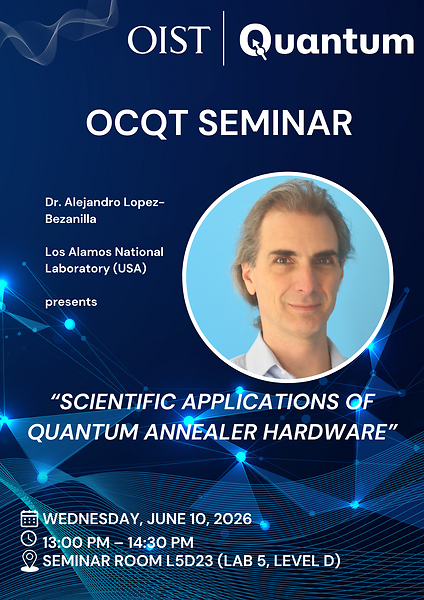
The OIST Center for Quantum Technologies (OCQT) is pleased to invite you to the next installment of the OCQT Seminar Series. This time, we are excited to host Dr. Alejandro Lopez-Bezanilla from Los Alamos National Laboratory (USA), who will deliver a talk entitled:
“Scientific Applications of Quantum Annealer Hardware”
Date and time
Wednesday, June 10, 2026, 13:00–14:30
13:00–13:30 — Networking with coffee and sweets
13:30–14:30 — Seminar
Location
Seminar Room L5D23 (Lab 5, Level D)
Abstract
Quantum Annealer (QA) hardware is setting a revolution in quantum computing but also in the way magnetism is studied. The qubit platform provided by D-Wave Quantum serves as a specialized qubit-based computer, leveraging superposition and entanglement to determine ground and excited states of Ising-type systems.
Magnetic lattices find in QAs inherent hardware solution to explore their configuration landscape with quantum fluctuations. In my presentation, I will showcase a series of studies unveiling the scientific competitive edge of this quantum technology.
By pinning individual magnetic moments, we demonstrate Gauss' law for emergent magnetic monopoles in two dimensions, along with purely entropic monopole-monopole screening interactions. Experiments on a frustrated kagome qubit lattice allow for the observation of quasi-particles resulting from consecutive annealing cycles.
Additionally, order-by-disorder-related phenomena are observed in a frustrated quantum system, where an effective temperature increase paradoxically enhances spatial correlations between qubit magnetic moments. Finally, I will present a material prototyping study demonstrating multiple spin textures in quasicrystal tilings when coupled to a modulating magnetic field.
Biography
Following the completion of his doctoral studies at CEA Grenoble in France, Alejandro Lopez pursued research positions at various U.S. national laboratories. He has been serving as a computational physicist at Los Alamos since 2017.
His expertise lies in employing diverse computational methodologies to investigate nanoscale materials, with a primary focus on comprehending the electronic, magnetic, and transport characteristics of low-dimensional systems. His professional career spans a wide spectrum of subjects, ranging from materials exploration to the development of programming techniques for quantum devices.
His most recent investigations revolve around magnetic lattices at the qubit scale using quantum annealing hardware.
Subscribe to the OIST Calendar: Right-click to download, then open in your calendar application.