



Virtual Seminar"Universal diagram for the kinetics of particle deposition in microchannels"Cesare M. Cejas
Date
Location
Description
Micro/Bio/Nanofluidics (Shen) Unit would like to invite you to the virtual seminar by Dr. Cesare M. Cejas on March 7 (Monday)
----------------------------------------------------------------------
Date: Monday, March 7, 2022
Time: 17:00-18:30
**Zoom session
----------------------------------------------------------------------
Join Zoom Meeting
https://oist.zoom.us/j/94937606426?pwd=SDJTNTdPS1IvYVFTMzQ4cEV3MjN1UT09
Meeting ID: 949 3760 6426
Passcode: 053648
Speaker:
Dr. Cesare M. Cejas
Founder & Head of MicrofluidicsX Ltd.
United Kingdom
Title:
Universal diagram for the kinetics of particle deposition in microchannels
Abstract:
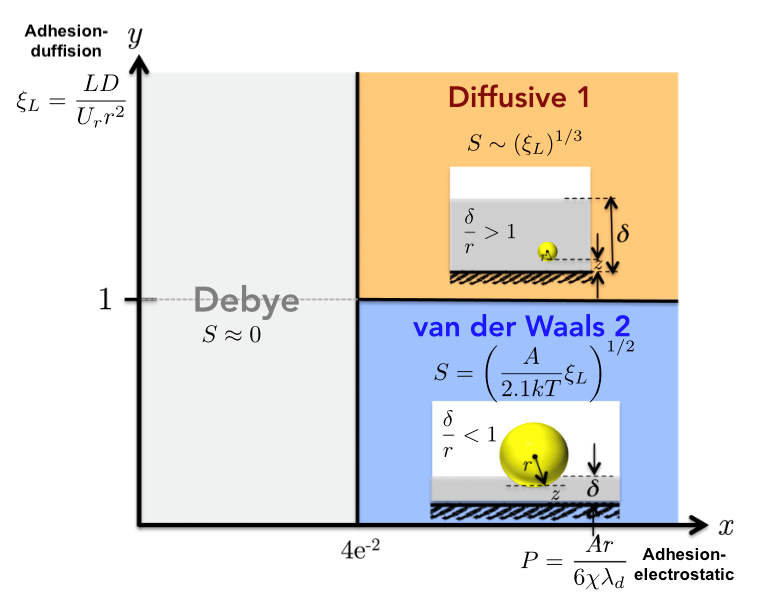
We present, using microuidics, a comprehensive description of particle deposition on microchannel walls for a broad range of experimental conditions (ow velocity, geometry, particle size, salt concentration). Near the channel wall, particles are subject to a wide array of forces that control their trajectories: hindered diffusion, hydrodynamic forces, electrostatic forces, and adhesion. By coupling controlled microuidic experiments, theoretical analysis, and numerical simulations, we establish a general description of the deposition phenomenon that considers situations of practical interest. We demonstrate the existence of three regimes: van der Waals, Debye and diffusive, in which particle deposition is dominated respectively by (attractive) van der Waals forces, (repulsive) electrostatic forces, and Brownian movement/diffusion. In a certain coordinate system, the universal diagram that embodies these regimes can be represented by a cantilever beam, in which the vertical support is defined by a dimensionless number incorporating the properties of the Debye layer with respect to adhesion forces and the horizontal beam is determined by the comparison between an effective Peclet number (advection-diffusion transport) and the Hamaker constant (adhesion forces). Results show that the theory is supported quantitatively by experiments and numerical simulations.
Also in this presentation, on a separate note, I will also present the challenges involved in the journey from academia to creating a start-up.
Host:
Prof. Amy Shen
Subscribe to the OIST Calendar: Right-click to download, then open in your calendar application.