



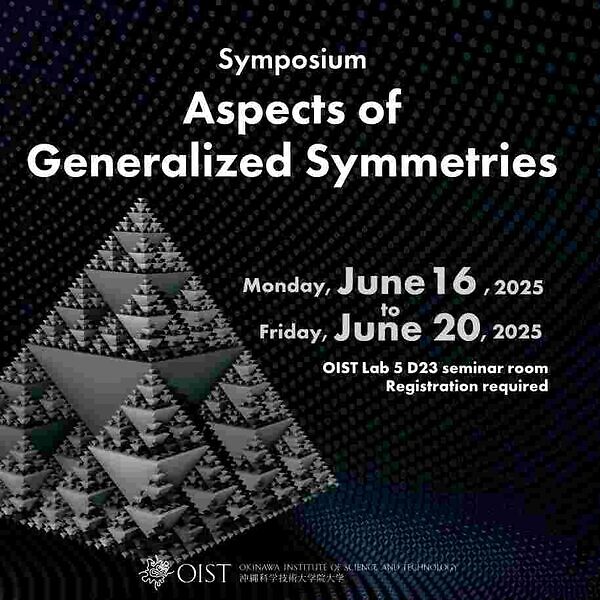
TSVP Symposium: Aspects of Generalized Symmetries
Date
Location
Description
Title: Aspects of Generalized Symmetries
Abstract: The concept of symmetry has long been a foundational principle in modern physics, providing a framework for classifying and understanding diverse physical systems based on shared invariances. Recently, the discovery of generalized symmetries has extended this framework, offering fresh insights across condensed matter physics, high-energy physics, quantum information, and mathematics. These symmetries go beyond conventional definitions, revealing new phases of matter and providing powerful tools for exploring complex phenomena such as fracton orders, categorical symmetries, non-invertible symmetries, and UV/IR mixing in field theories.
This symposium is part of the TSVP Thematic Program "Generalized Symmetries in Quantum Matter". The program will run from May 12 to July 5, 2025.
Registration -Closed
Register here (Deadline: 31 May, 2025)
Scientific Organizers
Danny Bulmash (United States Naval Academy)
Abhinav Prem (Institute for Advanced Study)
Masahito Yamazaki (The University of Tokyo)
Han Yan (The University of Tokyo)
Yizhi You (Northeastern University)
Invited participants
Myles Scollon (The University of Tokyo)
Marvin Qi (University of Chicago)
Haruki Watanabe (The University of Tokyo)
Salvatore Pace (MIT)
Takumi Fukushima (The University of Tokyo)
Ryohei Kobayashi (Institute for Advanced Study)
Chihiro Matsui (The University of Tokyo)
Pranay Gorantla (University of Chicago)
SungBin Lee (KAIST)
Luisa Eck (University of Oxford)
Zhu-Xi Luo (Georgia Institute of Technology)
Cenke Xu (University of California, Santa Barbara)
Kansei Inamura (University of Oxford)
Atsushi Ueda (Ghent University)
Masaki Oshikawa (The University of Tokyo)
Hiromi Ebisu (Kyoto University)
Sheng-Jie Huang (University of Oxford)
Ching-Yu Yao (The University of Tokyo)
Han Junghun (Sungkyunkwan University)
Schedule
June 16, 9:30 - 12:10: Opening Remarks, [Lattice Aspects of Generalized Symmetries]
13:30 - 16:30: [Open Quantum Systems]
June 17, 9:30 - 12:00: [Applications to Magnetism]
13:30 - Poster Session
June 18, 9:30 - 11:00: [Dualities] in L4E48
12:30 - 20:00: Excursion
June 19, 9:30 - 12:00: [Unconventional Quantum Phases]
13:30 - 15:00: [Quantum Dynamics]
15:30 - 16:30: Public Talk in L4E48
June 20, 9:30 - 11:05: [Non-invertible Symmetries in 1D], Closing Remarks
June 21: Free Discussion and Departure
Speakers on June 16 (Day 1)
Morning Session Theme: [Lattice Aspects of Generalized Symmetries]
Afternoon Session Theme: [Open Quantum Systems]
| 9:40-10:25 |
Sheng-Jie Huang University of Oxford |
Magic state preparation with the aid of non-Abelian topological order In fault-tolerant quantum computing with the surface code, non-Clifford gates are crucial for universal computation. However, implementing these gates using methods like magic state distillation and code switching requires significant resources. In this talk, I will talk about a new protocol to realize logical non-Clifford operations with the potential for fault tolerance. Our approach begins with a special logical state in the Z4 surface code. By applying a sequence of transformations given by gauging a global symmetry and anyon condensation, the system goes through different topological codes, including the non-Abelian D4 quantum double model. This process ultimately produces a magic state in a condensed Z2 surface code, which enables the implementation of a logical T gate in the standard Z2 surface code. This work addresses the challenge of achieving universal fault-tolerant quantum computation in strictly two spatial dimensions and introduces a new approach that leverages non-Abelian topological phases. This talk will be based on arXiv:2502.00998 with Yanzhu Chen. |
| 10:25-11:10 |
Hiromi Ebisu Kyoto University |
Foliated field theory and modulated symmetry Fracton topological phases now have diverse research interests, |
| 11:25-12:10 |
Salvatore Pace MIT |
Lattice T-duality from non-invertible symmetries in quantum spin chains Dualities of quantum field theories are challenging to realize in lattice models of qubits. In this talk, we will explore one of the simplest dualities, T-duality of the compact boson CFT, and its realization in quantum spin chains. In the special case of the XX model, we will discuss an exact lattice T-duality, which is associated with a non-invertible symmetry that exchanges two lattice U(1) symmetries. These U(1) symmetries flow to the momentum and winding symmetries in the CFT. However, their charge operators on the lattice do not commute and instead generate the Onsager algebra. Nevertheless, many features of the anomalies in the CFT are still exactly realized on the lattice. For example, these lattice U(1) symmetries enforce gaplessness and match the mixed ’t Hooft anomaly in the CFT. We further explore the simplest deformations of the XX model preserving both U(1) symmetries and lattice T-duality and find a rich gapless phase diagram. This talk will be based on arXiv:2409.12220 and arXiv:2412.18606 with Arkya Chatterjee and Shu-Heng Shao. |
| 13:30-14:15 |
Cenke Xu UCSB |
“Symmetry from Anomaly” in Condensed Matter related Models We discuss the mechanism of "symmetry-from-anomaly" in condensed matter-related models in both 1d and 3d spaces (which correspond to (1+1)d and (3+1)d space-time). Within the models discussed here, we establish the connection between field theory quantities such as different versions of the axial charge, and quantities with simple physical meanings in our systems. In our models and likely a class of related constructions, the existence of a topological order is necessary for the purpose of properly defining the axial symmetry. But the proper axial symmetry we define, though requires a topological order, is different from the noninvertible axial symmetry discussed in recent proposals. |
| 14:15-15:00 |
Zhu-Xi Luo Georgia Institute of Technology |
Tensor Network Representation of Intrinsically Mixed-State Topological phases We systematically construct tensor network representations for a broad class of intrinsically mixed-state topological phases and demonstrate that they are renormalization fixed points. Examples include tensor networks for generic Abelian topological orders subject to various decoherence channels, certain decohered non-Abelian Kitaev quantum doubles, and chiral topological phases in mixed states. |
| 15:30-16:15 |
Marvin Qi University of Chicago |
Equivalence of Gapless, Gapped, and Mixed SPTs From SymTFT One dimensional spin chains display a surprisingly rich array of possible phases. We establish a correspondence between three such phases: gapless SPTs with G symmetry, a subset of gapped SPTs with G x G symmetry, and mixed state SPTs. In doing so, we extend the framework of SymTFT to mixed states and explore some of its applications. |
Speakers on June 17 (Day 2)
Morning Session Theme: [Applications to Magnetism]
Afternoon: Poster Session* *Please find poster presenters' information below.
| 9:30-10:15 |
Han Yan The University of Tokyo |
Designing Light in an Artificial Universe of QED Quantum spin ice (QSI) is a lattice spin-model realization of full-fledged quantum electrodynamics, including photons, electric charges, and magnetic monopoles [1]. As one of the most interesting quantum spin liquids, a significant amount of experimental and theoretical investigation has been done in this field. I will present an overview of the quantum spin ice physics and also discuss our recent ongoing work [2] on how, in the so-called dipole-octupole QSI [3], one can experimentally have clean control of the dynamics of its emergent QED, including the transition between different symmetry-enriched phases, tuning the dispersion of photons and fine-structure constants, etc. One of the most straightforward experiments can achieve this: turning on the external magnetic field in the right direction. [1] Experimental signatures of emergent quantum electrodynamics in Pr2Hf2O7, Romain Sibille, Nicolas Gauthier, HY et al., Nature Physics 14, 711–715 (2018) |
| 10:15-11:00 |
Sungbin Lee KAIST |
Exotic quantum phases in quasiperiodic systems Quasiperiodic systems offer a unique platform for realizing exotic quantum phases that challenge conventional understanding of condensed matter phenomena. In this work, we explore the emergence of long-distance magnetic correlations, multipolar physics and pattern-selective superconductivity in quasiperiodic systems. By tuning quasiperiodicity parameters and interaction strengths, we identify the emergence of unexpectedly long-range magnetic correlations in the absence of translational symmetry. In addition, we also point out that quasicrystals could generically host the multipolar degrees of freedom. Furthermore, we demonstrate that superconducting pairing in quasiperiodic systems can exhibit strong spatial selectivity, favoring distinct local configurations — an effect rooted in the underlying aperiodic geometry. These findings shed light on the interplay between structural complexity and collective quantum behavior, opening new avenues for designing materials with unconventional magnetic and superconducting properties. |
| 11:15-12:00 |
Haruki Watanabe The University of Tokyo |
General Properties of Frustration-Free Quantum Many-Body Systems Frustration—alongside symmetry—fundamentally constrains the behavior of quantum many-body systems. A frustration-free Hamiltonian, in which every local term is simultaneously minimized by the ground state, imposes a strong local constraint that leads to phenomena rarely realized in generic frustrated models. Gapless frustration-free systems, for example, display an unusually small finite-size gap that scales as $O(1/L^{2})$, while gapped systems can sustain exact ground-state degeneracy on finite systems, permitting spontaneous breaking of continuous U(1) symmetry even in one dimension. Frustration-freeness also intertwines non-trivially with topology: it is widely believed, for instance, that a finite-range frustration-free Hamiltonian cannot realize a Chern insulator. |
Speakers on June 18 (Day 3)
Morning Session Theme: [Dualities]
| 9:30-10:15 |
Luisa Eck University of Oxford |
Dualities between 2+1d fusion surface models from braided fusion categories Fusion surface models extend the framework of anyon chains to 2+1 dimensions. Constructed from braided fusion categories, these lattice models exhibit categorical 1-form symmetries and provide systematic generalizations of Kitaev’s honeycomb model. Many of them are promising candidates for realizing chiral topological order. In this talk, I will discuss how the fusion surface model framework can be extended to accommodate dualities—understood as gauging of 1-form symmetries. The dual models can potentially exhibit independent 0-form symmetries and realize symmetry-enriched topological order. As an example, I will present a duality between a spin-1/2 model on the honeycomb lattice and a constrained Hilbert space model with a Rep(S3) 1-form symmetry. This balk is based on arXiv:2408.04006, 2501.14722. |
| 10:15-11:00 |
Masahito Yamazaki The University of Tokyo |
Dualities and Exact Quantum Many-Body Scars I will discuss the interplay between dualities and exact quantum many-body scars, motivated by my recent papers arXiv:2505.21921 and arXiv:2501.12514. |
Speakers on June 19 (Day 4)
Morning Session Theme: [Unconventional Quantum Phases]
Afternoon Session Theme: [Quantum Dynamics] + [Public Talk]
| 9:30-10:15 |
Pranay Gorantla University of Chicago |
p-string condensation as gauging a 1-form symmetry Coupled-layer constructions are invaluable for constructing exactly-solvable models of phases of matter. For example, the 3+1d X-cube model, a prototypical example of fractons, can be constructed by starting with a stack of 2+1d toric codes and turning on a coupling which condenses a particular composite object called a "particle-string" or "p-string". In this talk, I will show that the p-string can be thought of as a symmetry defect of a topological 1-form symmetry and reinterpret p-string condensation as the gauging of this higher-form symmetry. This approach clarifies the symmetry principles underlying p-string condensation and generalizes the familiar connection between anyon condensation and one-form gauging in 2+1d. Finally, I will comment on a rich gauging web relating the X-cube model, the 3+1d toric code, and SPT phases protected by both subsystem and higher-form symmetries, which exhibit phenomena such as subsystem symmetry fractionalization, as well as non-trivial extensions between subsystem and topological symmetries. |
| 10:15-11:00 |
Kansei Inamura University of Oxford |
Generalized gauging on the lattice and gapped phases with non-invertible symmetries in 2+1d Gauging is a systematic way to construct a model with non-invertible symmetry from a model with ordinary group symmetry. In 2+1 dimensions or higher, one can generalize the standard gauging procedure by stacking a symmetry-enriched topological order before gauging the symmetry. This generalized gauging procedure allows us to realize a large class of non-invertible symmetries. In this talk, I will describe the generalized gauging of finite group symmetries in 2+1d lattice models. By applying the generalized gauging to gapped phases with ordinary group symmetry, I will construct commuting projector models for gapped phases with non-invertible symmetry. |
| 11:15-12:00 |
Ryohei Kobayashi Institute for Advanced Study |
Generalized symmetry in quantum codes: Logical gates in Z2 gauge theory It has recently been understood that the complete global symmetry of topological gauge theories contains the structure of a higher-group. In this talk, we look at the global symmetry in Z2 gauge theory, and describe how the higher-group symmetries of the gauge theory leads to comprehensive understanding of logical gates of the quantum codes. |
| 13:30-14:15 |
Pranay Patil OIST |
Anomalously slow equilibration under dipole moment conserving dynamics Models of interacting particles with conserved quantities beyond particle number can lead to strong constraints on the pathways of relaxation to equilibrium. This can lead to a qualitative change in the timescale associated with the relaxation of even more severe effects like glassiness, where the system fails to equilibrate at all. This has already been studied for one-dimensional spin chains and here we consider a simple two-dimensional model to investigate relaxation for slowly varying macroscopic structures such as density waves with a long wavelength. We find that we are able to tune smoothly between a glassy regime and one controlled by sub-diffusive behavior using just the macroscopic features of the initial state. This result shows that the time required before a hydrodynamic description kicks in can be anomalously large, leading to real systems which are practically never controlled by the expected hydrodynamic behavior. |
| 14:15-15:00 |
Chihiro Matsui The University of Tokyo |
Weak ergodicity breaking and embedded integrability Non-thermal energy eigenstates of thermalizing isolated quantum systems have been intensively studied these days, as counter examples for the strong eigenstate thermalization hypothesis. Nowadays, it is believed that, based on many numerical evidence, these exceptional non-thermal states emerge when the Hamiltonian has a relatively small invariant subspace, which weakly violate ergodicity in the Hilbert space.
|
| 15:30-16:30 |
Zhu-Xi Luo Georgia Institute of Technology |
Public Talk: Talk Title Coming soon... |
Speakers on June 20 (Day 5)
Morning Session Theme: [Non-invertible symmetries in 1D]
| 9:30-10:15 |
Junghun Han Sungkyunkwan University |
Noninvertible Symmetry in 1D SPT Models with Modulated Symmetries We examine the noninvertible symmetry (NIS) in one-dimensional (1D) SPT models protected by dipolar and exponential-charge symmetries, which are the two examples of modulated SPT, or MSPT for short. To lay the ground, we first consider the NIS of the Z_N x Z_N cluster model, which is an example of SPT protected by two charge symmetries, while an earlier work considered the NIS of Z_2 x Z_2 cluster model. In all three models of SPT with charge, dipole, and exponential-charge symmetries, we explicitly work out the noninvertible Kramers-Wannier (KW) as well as the Kennedy-Tasaki (KT) transformation, arriving at the dual models exhibiting spontaneous symmetry breaking (SSB). An alternative model of SSB is written down in each case which, upon the KT transformation, gives rise to new kinds of SPT models. The distinctiveness of the new SPT models from the cluster models is demonstrated by performing the projective symmetry analysis at the interface of the two models. Our investigation lays the groundwork for the broad theme of modulated SPTs in possession of noninvertible symmetries, or NIMSPT. In addition, we employ the topological holography picture to account for the emergence of each of the SPT models considered, by identifying the appropriate two-dimensional (2D) topological model whose boundary physics give rise to the 1D SPT in question. The 2D bulk models that have been identified are two coupled layers of toric codes (for the charge SPT), one layer of anisotropic dipolar toric code (for the dipolar SPT), and two coupled layers of exponentially modulated toric codes (for the exponential SPT). We thus enlarge the horizon of 1D and 2D correspondence through topological holography to the case of MSPT. |
| 10:15-11:00 |
Masaki Oshikawa The University of Tokyo |
Talk Title Coming soon... |
Poster Presenters
| 1 |
Haruki Yagi The University of Tokyo |
On universality classes of typical entanglement under symmetries. |
| 2 |
Zhian Jia National University of Singapore |
Lattice model for non-invertible symmetry-protected topological phase |
| 3 |
Stephan Haas University of Southern California |
Interactions and Disorder in Topological Quantum Systems |
| 4 |
Takuma Saito Kyoto University |
Classifying formula for 1D abelian multipole SPT |
| 5 |
Yoshiki Fukusumi National center for theoretical sciences |
Series of exotic (or new) coupled models and domain walls from extension of conformal field theories |
| 6 |
Sumiran Pujari Indian Institute of Technology Bombay |
<<Anticommuting>> Z2 quantum spin liquids |
| 7 |
Pochung Chen National Tsing Hua University |
Extracting conformal data via tensor network methods |
| 8 |
Nagare Katayama Kyoto University |
2d Cardy-Rabinovici model with Modified Villain lattice formulation |
| 9 |
Jun Maeda Kyoto University |
Twisted Partition Functions as Order Parameters |
| 10 |
Tsubasa Oishi Kyoto University |
N-ality symmetry and SPT phases in 1+1d |
| 11 |
Shunta Takahashi Kyoto University |
Anyon Condensation in Quantum Gravitational TQFT |
| 12 |
Yuki Furukawa The University of Tokyo |
Lattice models with subsystem/weak non-invertible symmetry-protected topological order |
| 13 |
Michele Fossati SISSA |
Entanglement asymmetry for non-invertible symmetries |
| 14 |
Saswato Sen OIST |
Critical phenomena in hyperbolic lattices |
※ Please note that this event may be recorded and the videos uploaded. In addition, photos may be taken during the event. These are intended for publication online (the OIST website, social media, etc.)※
Attachments

Subscribe to the OIST Calendar: Right-click to download, then open in your calendar application.