



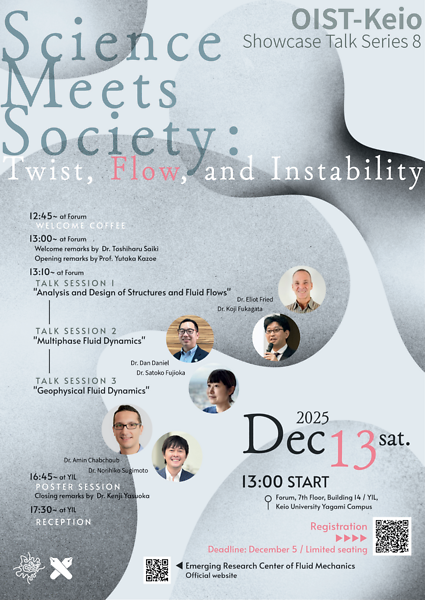
OIST-Keio Showcase Talk Series Vol. 8 "Science Meets Society: Twist, Flow, and Instability"
Date
Location
Description
Title
OIST-Keio Showcase Talk Series Vol. 8 "Science Meets Society: Twist, Flow, and Instability"
Symposium Abstract
The 8th OIST-Keio joint symposium explores the interplay of fluid mechanics, wave phenomena, and structural transformations, highlighting their impact on science and society. From gravity waves and multiphase reactors to extreme wave events, evaporating drops, and geometric linkages, six talks will showcase cutting-edge research at the intersection of physics, engineering, and applied mathematics. Additional topics will be explored in a poster session. The event aims to foster a dialogue between Keio and OIST researchers, enabling innovation through interdisciplinary collaboration.
Program
*Please note that the program is subject to change without prior notice.
Registration
Registration is closed.
Keio Speakers
| Speakers | Affiliation | Talk Title/Abstract | |
| 1 |
Professor |
Spontaneous gravity wave radiation in geophysical fluid Inertia-gravity waves (IGWs) play important roles in both the atmosphere and ocean through their momentum fluxes. They drive the middle atmosphere’s circulation and make a pathway for energy toward small scales where dissipation can occur in the ocean. Their small scales are such that they need to be parameterized, requiring a good fundamental understanding of their dynamics, from their sources to their dissipation. A persistent difficulty has concerned non-orographic waves generated by the dynamics near jets and fronts, which is tied to the difficult and fundamental issue of gravity wave generation from balanced motions, or ‘spontaneous generation’. In this talk, we will present numerical simulations of spontaneous gravity wave radiation in f-plane shallow water and continuously stratified systems and discuss its mechanism and impact on the atmosphere and ocean. |
|
| 2 |
Associate Professor |
A novel design for multiphase flow reactors enabling continuous chemical processes Technologies for process intensification (PI) are actively being developed to dramatically enhance the efficiency and miniaturization of chemical processes. Our research group focuses on developing multiphase flow reactors, such as slug flow reactors and oscillatory baffled reactors, to enable highly efficient continuous processes. |
|
| 3 |
Professor |
Applications of CNN autoencoders to fluid mechanics problems Application of machine learning is currently one of the hottest topics in fluid mechanics. In our research group, we have started a research project to construct a machine-learning-based nonlinear feature extraction method for an advanced design of flow control. In this talk, we first introduce the structure of a convolutional neural network (CNN)-based autoencoder and compare with a conventional linear method. Then we introduce some examples on the application of for temporal prediction of a turbulent flow field and extraction of low-dimensional nonlinear modes for flow around a bluff body accompanying vortex shedding. We also introduce our recent attempt on its use for an advanced design of flow control. |
OIST Speakers
| Speakers | Affiliation | Talk Title/Abstract | |
| 1 |
Dr. Dan Daniel Transitional Assistant Professor |
An Electrifying Farewell: How Evaporating Drops Charge and Explode When a drop evaporates, it is easy to think of it as a purely thermal and mass-transfer process. In reality, subtle electrohydrodynamic phenomena can transform its quiet demise into a highly charged and sometimes violent event. In this talk, I will explore how sessile water drops spontaneously acquire and redistribute electrical charge during evaporation, leaving behind intricate bipolar surface charge patterns [1]. Under certain conditions—such as when contact-line pinning is eliminated—the shrinking drop can accumulate enough charge to approach its electrostatic stability limit. At this point, electrostatic repulsion overwhelms surface tension, triggering Coulombic explosions and fine spray ejection [2, 3]. These findings reveal evaporation as a rich playground for soft matter physics, where thermal, hydrodynamic, and electrostatic forces converge to produce surprising dynamics. |
|
| 2 |
Dr. Amin Chabchoub Associate Professor |
The Hydrodynamics of Extreme Wave Events Extreme ocean waves, often referred to as rogue or freak waves, represent some of the most hazardous and scientifically fascinating phenomena in hydrodynamics. This talk will explore the fundamental mechanisms underlying their formation, focusing on the competition between linear superposition and nonlinear modulation instability. By bridging theoretical modeling, numerical simulations, and laboratory experiments, we will discuss how these two frameworks contribute to our understanding of wave energy focusing and the onset of extreme sea states. Special attention will also be given to the hydrodynamic loading on marine structures during such events, highlighting challenges in prediction and design resilience. Finally, perspectives will be offered on current strategies for disaster risk mitigation, including early-warning methodologies and the development of smart structures capable of absorbing wave energy. |
|
| 3 |
Dr. Eliot Fried Professor |
From underconstrained linkages to Möbius bands: Isometric, isoenergetic pathways of eversion We connect the kinematics of underconstrained rings of rigid links with isometric, isoenergetic eversions of elastic Möbius bands. Our starting point is the family of Möbius kaleidocycles, closed chains of n ≥ 7 identical links joined by revolute hinges. The twist angle between successive hinges must assume an n-dependent critical value to achieve closure with a single internal degree of freedom. At this value, the linkage admits only one mode of motion: an eversion. Closure is not possible for subcritical angles, and supercritical angles yield multiple internal degrees of freedom, so that a Möbius kaleidocycle is underconstrained for n ≥ 8. As n ⤏ ∞, the Möbius kaleidocycles approach a ruled Möbius band with three half-twists and three-fold rotational symmetry. Guided by this understanding, we study the inverse problem of identifying stable isometric deformations of circular helicoids to Möbius bands and characterizing their periodic shape-preserving eversions. For an elastic band with bending-energy density that is an even function of the mean curvature, an isometric eversion requires no external work. A nonuniform finite-difference scheme applied to the midline of these bands generates families of linkages that preserve a single internal degree of freedom under arbitrary link rearrangements. Through this synthesis, we establish correspondences between underconstrained mechanisms and isoenergetic eversions of bands, with possible implications for propulsion, mixing, and deployable structures. |
Poster Presenters
| Speakers | Affiliation | Talk Title/Abstract | |
| 1 |
Dr. Simon Haward Senior Staff Scientist, OIST |
Exploring multi-stability in three-dimensional viscoelastic flow around a free stagnation point Fluid elements passing near a stagnation point experience finite strain rates over long persistence times, and thus accumulate large strains. By the numerical optimization of a microfluidic 6-arm cross-slot geometry, recent works have harnessed this flow type as a tool for performing uniaxial and biaxial extensional rheometry [Haward et al J. Rheol. 67 (2023) 995-1009; Haward et al J. Rheol. 67 (2023) 1011-1030]. Here we use the microfluidic ‘Optimized-shape Uniaxial and Biaxial Extensional Rheometer’ (OUBER) geometry to probe an elastic flow instability which is sensitive to the alignment of the extensional flow. A three-dimensional symmetry–breaking instability occurring for flow of a dilute polymer solution in the OUBER geometry is studied experimentally by leveraging tomographic particle image velocimetry. Above a critical Weissenberg number, flow in uniaxial extension undergoes a supercritical pitchfork bifurcation to a multi-stable state. However, for biaxial extension (which is simply the kinematic inverse of uniaxial extension) the instability is strongly suppressed. In uniaxial extension, the multiple stable states align in an apparently random orientation as flow joining from four neighboring inlet channels passes to one of the two opposing outlets; thus forming a mirrored asymmetry about the stagnation point. We relate the suppression of the instability in biaxial extension to the kinematic history of flow under the context of breaking the time-reversibility assumption. |
|
| 2 |
Mr. Hanley Andrean PhD student, OIST |
Towards new conceptual understanding of the decay of landfalling typhoons When a typhoon makes landfall, its intensity sharply decays. The decay is conceptually understood by treating the typhoon as a vortex that decays due to friction underneath. The conceptual picture is based on a spin-down vortex theory that describes a vortex that is much simpler than a typhoon. We test the decay prediction from the spin-down model with the results from idealized landfall of a typhoon and examine the core idea of the spin-downmodel. We show that the model’s prediction highly overestimates the decay rate of a typhoon and fitting data to the model may misguide our understanding. Finally, we propose that a new model must contain a key thermodynamic element in addition to friction and present a thermodynamic effect past landfall. |
|
| 3 |
Ms. Morie Koseki PhD student, OIST |
The effects of wall flexibility in turbulent channel flow over a deformable wall When fluids flow over deformable walls, the flow field is modified by the fluid-wall interactions. The complex coupling can be described by a combination of many undistinguished effects, e.g., roughness effects (due to the wall deformation by the hydrodynamic force), non-zero wall-normal fluctuations (coming from the wall movement), and wall motion (owing to the wave propagation on the surface and inside materials). This study aims to disentangle the effects of fluid-structure interaction and wall shape/undulations individually in a turbulent flow. We conduct direct numerical simulations of turbulent channel flows over deformable and statistically equivalent rough walls. Turbulent flows over relatively rigid compliant walls share similar features to those over rough walls; however, as wall flexibility increases, distinct effects are observed that are specific to the mutual fluid-structure interaction. |
|
| 4 |
Mr. Soratsugu Sakazume PhD student, Keio |
|
PIV-based validation of friction drag reduction by streamwise traveling wave-like wall deformation in turbulent channel flow This study experimentally investigates the friction drag reduction effect of streamwise traveling wave–like wall deformation driven by a single actuator in turbulent channel flow. Wind tunnel experiment was conducted to validate the control concept in which a thin silicone rubber wall is oscillated by a voice coil motor to generate a traveling wave–like deformation along the streamwise direction. The velocity field within the test section was measured using particle image velocimetry (PIV) under both controlled and uncontrolled conditions. As a result, the bulk mean velocity increased by 13.6%, corresponding to a friction drag reduction rate of 22.6%. However, due to the large power consumption of the actuator, a net energy saving effect was not achieved. However, it was found that the flow was not in a fully developed turbulent state due to insufficient test section length, which limited the accuracy of the friction drag reduction. To address this issue, turbulence promoters were installed at front of the test section to validate the effects. These results demonstrate the potential of streamwise traveling wave-like wall deformation for friction drag reduction and provide valuable experimental validation for future practical implementation. Future challenges include reproducing fully developed turbulence through improvements to test section and optimizing control input to improve net energy saving. |
| 5 |
Mr. Nobuaki Ikeda PhD student, Keio |
A pressure drop-based method for rheological characterization of food fluids: From methodology to device development This study focuses on developing a novel pressure-driven rheometric method and clarifying its differences from conventional rotational viscometry. The rotational viscometer determines shear stress from torque in a narrow gap and continuously accumulates shear deformation during measurement. In contrast, the pressure-driven rheometer estimates wall shear stress and shear rate from the pressure drop and flow rate within a pipe, enabling measurements under constant shear deformation based on the Herschel–Bulkley model. To evaluate its performance, measurements were conducted using tamarind seed gum and xanthan gum aqueous solutions, as well as low-oil-type mayonnaise. The flow curves obtained by both methods showed good agreement for tamarind seed gum aqueous solution, whereas deviations increased for xanthan gum aqueous solution and low-oil-type mayonnaise, especially at high shear rates. These discrepancies were attributed to differences in internal structural robustness and cumulative shear strain. The developed device requires only a pressure sensor and a flowmeter, allowing simple and flexible rheological evaluation. The results demonstrate that this pressure-driven method provides stable measurements while minimizing structural breakdown, offering a promising laboratory-scale approach for rheological analysis of complex food fluids. |
|
| 6 |
Dr. Masafumi Watanabe PhD student, Keio |
Femtoliter-sample injection by highly-integrated nanofluidic valves and its application to nanochannel chromatography The development of micro/nanofluidics has enabled reaction times to be shortened and reagent volumes to be reduced. To realize complex chemical processing, we previously developed nanofluidic open/close valves based on the nanoscale elastic deformation of glass using piezoelectric actuators, while integrating the valves at intervals of several hundred micrometers remains challenging. Therefore, in the present study, we aim to develop a water pressure-driven valve and integrate the valves on a nanofluidic device to achieve femtoliter (fL) sample injection. In the valve system, a microchannel for applying water pressure and a thin glass deformation part were placed above the valve chamber to switch the valves between open and closed states. To perform fL sample injection, we highly integrated four valves, whose response time and open/close ratio were approximately 0.9 s, with a minimum spacing of 700 µm on a nanofluidic device, enabling fL-scale fluid manipulation of a mixture of fluorescent molecules (=567 fL) by switching the valves sequentially. This mixture was then introduced into the nanochannel for chromatography, resulting in the successful separation of the fluorescent molecules at the detection point. We believe that the developed fL sample injection system can be applied to various chemical analyses in the future. |
Co-hosts
Event News
【Event Report】 OIST-Keio Showcase Talk Series Vol. 8 "Science meets Society: Twist, Flow, and Instability"
Contact
Please email academic-partnerships@oist.jp if you have any questions.
※ Please note that this event may be recorded, and the videos may be uploaded by OIST/Keio U. Additionally, photos may be taken during the event for publication online (e.g., the OIST website, social media, etc.). Any non-published information will not be shared. ※
Attachments

Subscribe to the OIST Calendar: Right-click to download, then open in your calendar application.