



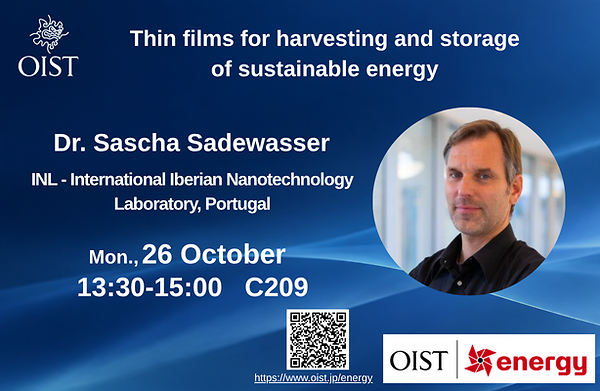
Energy Open Center - "Thin films for harvesting and storage of sustainable energy"
Date
Location
Description
Speaker
Dr. Sascha Sadewasser, Iberian Nanotechnology Laboratory (INL), Portugal
Title
Thin films for harvesting and storage of sustainable energy
Abstract
The transition to a clean energy system is required to combat climate change. The direct conversion of solar energy into electricity through photovoltaics (PV) is an essential pillar in a clean energy system. While the market is dominated by crystalline silicon PV, thin-film PV provides advantages for specific applications, e.g. in building-integrated PV (BIPV). The Cu(In,Ga)Se2 (CIGSe) thin-film PV technology has demonstrated competitive power conversion efficiencies above 23%.
Specifically interesting for BIPV are semi-transparent PV (STPV) as windows. We are developing micro-patterned STPV that ensure color-neutral light transmission. Proof-of-concept CIGSe solar cells were fabricated by chemically etching a full solar cell, leading to spatially segmented micro-sized line-shaped solar cells, invisible to the human eye at practical distances. Semi-transparent CIGSe solar cells with a total area efficiency of 7.6 % and an average visual transmittance (AVT) of 45 % [1,2] were achieved. To ensure large-scale material-efficient fabrication, we also develop selective-area deposition processes, and devices reach about 10% active-area efficiency [3].
On the other hand, to improve the understanding of the limitations of polycrystalline CIGSe solar cells, we apply atomic force microscopy (AFM) methods to study their nanoscale electronic properties. Using Kelvin probe force microscopy (KPFM), we have shown that the electronic properties of grain boundaries (GBs) are beneficially modified by an alkali-fluoride post-deposition treatment (AlkF-PDT). Different potential variations at GBs are found for different alkali elements (K, Rb, and Cs), interpreted as hole and electron barriers. These barriers impact the open-circuit voltage of reference solar cell devices. Our findings suggest an effective passivation effect promoted by the AlkF-PDT [4]. To understand the impact below the near-surface region, we additionally applied a novel conductive AFM tomography method [5].
On the other hand, thin film materials are increasingly being explored for energy storage. Thin-film solid-state microbatteries are interesting for applications in portable devices, IoT, wearable biosensors, and silicon-based electronics. Their development and integration into compact systems depend on deposition techniques compatible with semiconductor manufacturing, such as magnetron sputtering, atomic layer deposition (ALD), and thermal evaporation, which allow precise control over thickness, composition, interface quality, and uniformity. However, achieving stable electrode-electrolyte interfaces remains complex due to interfacial reactions, transition metal diffusion, and mechanical stress during cycling. We recently fabricated all SnO2/TiO2 nanocomposite thin films as anodes for thin film batteries, showing significant improvements in cycle life with high coulombic efficiency.
[1] P. Santos, …, S. Sadewasser, Thin Solid Films 770, 139778 (2023).
[2] S. Shital, …, S. Sadewasser, P.J. Dale, EES Solar 2, 733 (2026).
[3] N. Rodrigues, …, S. Sadewasser, 10, e70347 (2026).
[4] N. Nicoara, …, S. Sadewasser, Nature Commun. 10, 3980 (2019).
[5] D. Sharma, …, S. Sadewasser, Nature Energy 9, 163 (2024).
Attachments

Subscribe to the OIST Calendar: Right-click to download, then open in your calendar application.