



Mini Course: Computer Vision and Machine Learning for Scientific Visual Data Analytics
Date
Location
Description
This is Session 1
Please REGISTER here if you plan on coming...
UPDATE: Course is now full, any further registrations are on a wait-list basis
10:00-12:00, Monday & Wednesday
June 29 to July 27
- 8 sessions, 4 weeks in total
- July 20 Monday is a public holiday
Description
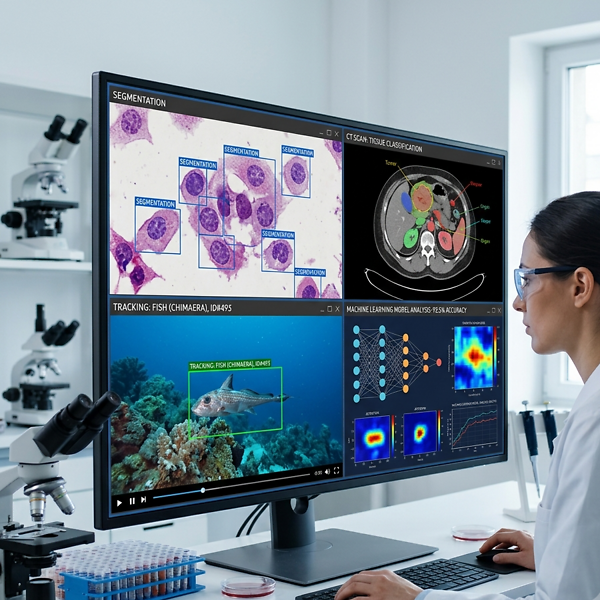
This course introduces computational techniques of Computer Vision and Machine Learning (CV/ML) to scientific visual data analysis. Scientific visual data can be CT scans, microscope imagery, remove sensing imagery, videos captured from camera trap, etc. The course focuses on CV/ML techniques and briefly introduces their applications in palynology, ecology and marine science. It covers topics such as the following, but not limited to:
- Basics of CV/ML such as nearest neighbor, classification, regression, clustering;
- Fundamental and advanced CV/ML algorithms such as Support Vector Machine, supervised/self-supervised/semi-supervised learning, neural networks, deep learning, pretraining and finetuning, and Artificial Intelligence;
- Scientific applications of CV/ML such as animal species recognition, object detection in image, object tracking in video, and extinct species detection.
Furthermore, the course contains hands-on programming exercises to solidify students’ knowledge and skills learned from this course, covering the above topics. The course will use Google Colab as the programming environment and provide step-by-step configurations. The data used in the course is mainly microscope scans of pollen data but students are encouraged to bring in their own scientific visual data to test algorithms and discuss potential use cases with the instructor.
In this course, each session is 2-hour long, consisting of a lecture and hands-on exercise. No readings are required; lectures will suggest papers as offline readings.
Target audience
Students who work on scientific visual data are welcome to register. Scientific visual data can be CT scans, microscope imagery, remove sensing imagery, videos captured from camera trap, etc. While this course will be prepared to be self-contained, familiarity with the following will be of great help:
- Python: we will use Python as the programming language in hands-on exercises.
- Basic linear algebra, statistics, and probability: we will need them to understand CV/ML algorithms.
Registered students are expected to have a Google account to be able to use Google Colab for programming and Google Drive to store data.
Bio
Shu Kong is a TSVP scholar at OIST and an Assistant Professor at the University of Macau. He was with Carnegie Mellon University and Texas A&M University. He holds a Ph.D. from UC Irvine. His interdisciplinary research builds an automated high-throughput pollen analysis system, which was highlighted by the U.S. National Science Foundation as "opening a new era of fossil pollen research".
Pre-reading suggestions (not required)
Below are some open resources to understand the programming environment and foundations in math and CV/ML. Some contents therein are more advanced than being expected in this course.
- Google Colab for python programming with GPU
- PyTorch for deep learning
- a YouTube list of college level linear algebra
- YouTube lists of computer vision
Subscribe to the OIST Calendar: Right-click to download, then open in your calendar application.